
Every feature from all five editions for 15 days, no sign-up.
Method Validation edition from US$ 475 a year · 30-day money-back guarantee.
Excel’s AVERAGE and STDEV functions give one mean and one standard deviation and stop. No variance components, no confidence interval on a CV, no test against a claim, no allowable-error bands. Before clinical use a measurement procedure needs four things established: precision, trueness, linearity across the reportable range and the lowest concentration it can detect. Each characteristic has its own CLSI protocol, its own experimental design and its own acceptance criteria. Doing the work in separate tools means re-entering data and reconciling formats at every hand-off, a risk when the results feed a 510(k) submission or an accreditation file.
Is the imprecision within the claim, and which component drives it? Is the bias within the allowable bias at every level, or only on average? Where does the assay stop being linear, and what is the reportable range? Where do LoB, LoD and LoQ fall? Analyse-it runs all five protocols in one analysis, on one experiment design with nested factors. The precision profile feeds straight into LoB, LoD and LoQ, with no re-entering of data.
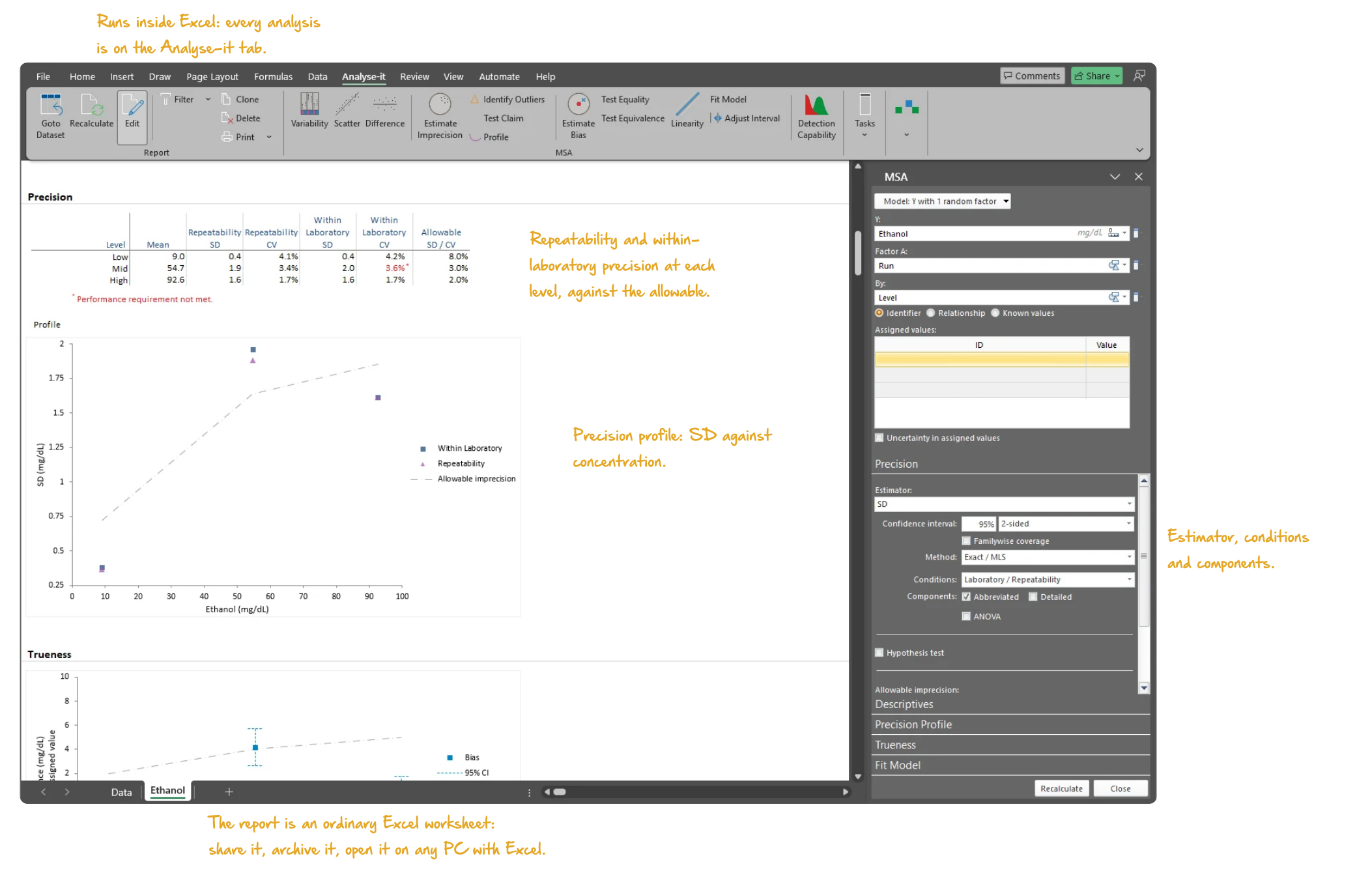
A single SD hides where the imprecision comes from. Variance component analysis per EP05-A3 separates repeatability from the between-run, between-day, between-operator and between-site contributions, with exact, Satterthwaite or MLS confidence intervals. Designs are flexible: up to three random nested factors and one fixed factor in any arrangement, balanced or unbalanced. Run 3 sites × 5 days × 2 runs × 3 replicates, or a single-laboratory 20 × 2 × 2 design. A precision profile shows how imprecision changes across the measuring range, with seven variance function models that feed directly into detection capability estimation. Generalised ESD outlier identification and a variability of measurements plot check the data first.
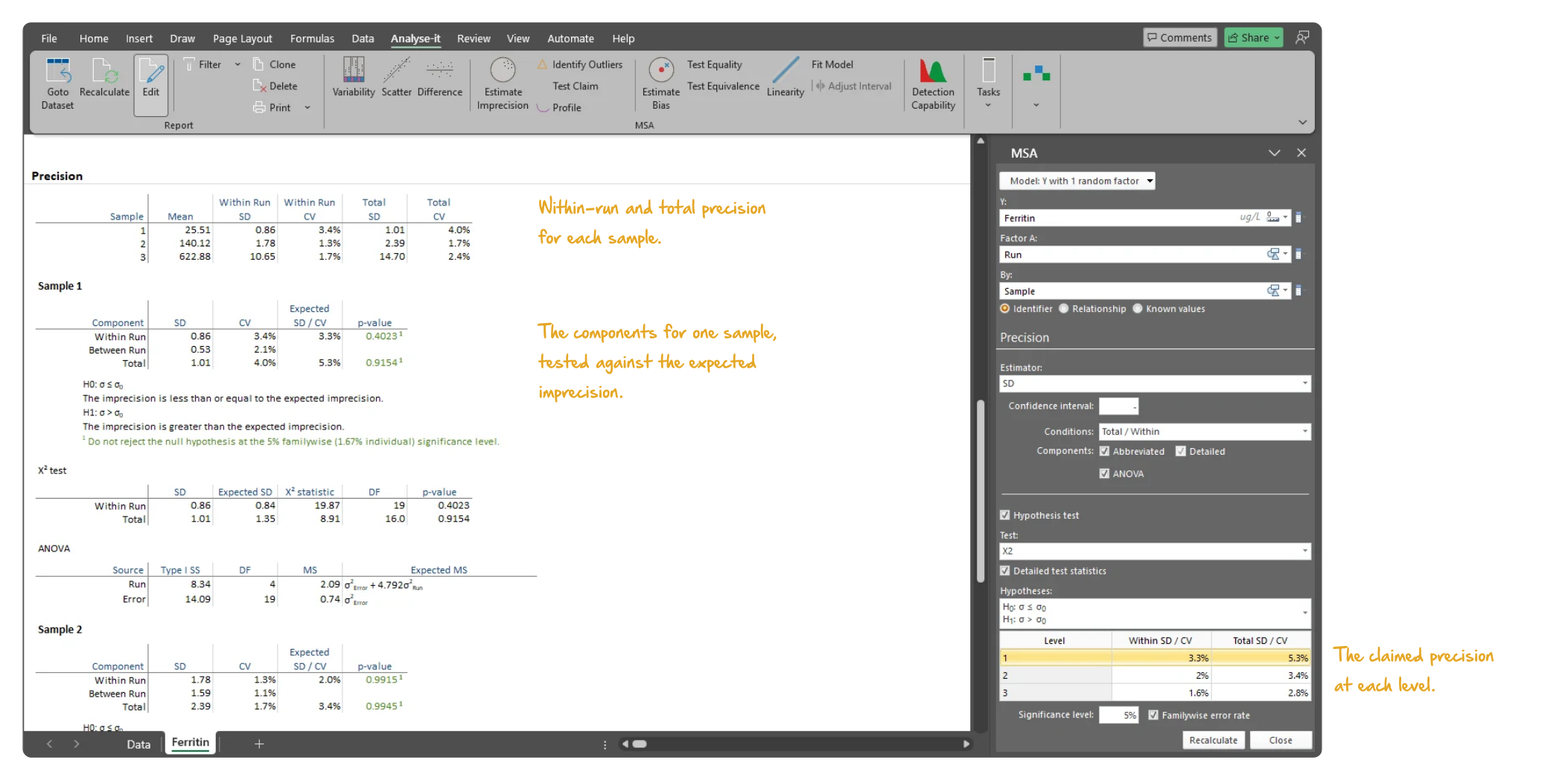
Verification is a pass/fail question: is the imprecision within the manufacturer’s claim? The EP15-A3 design, 5 runs × 5 observations on each sample, gives within-run and total precision for each sample. A χ² test compares each against the claimed SD or CV and reports the p-value, so the verdict rests on a test rather than a visual comparison.
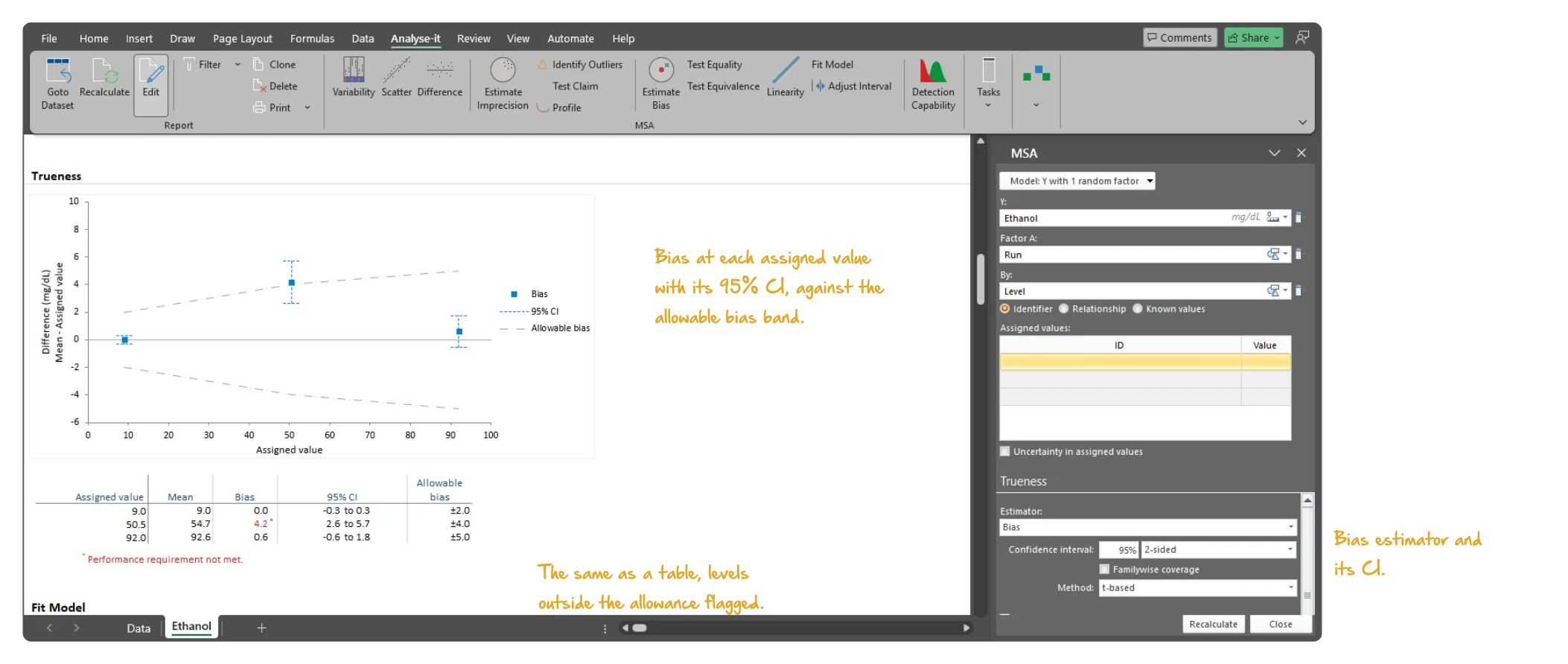
A bias estimate on its own does not say whether the bias matters. Bias against each assigned value is reported with its confidence interval and tested two ways. Equality asks whether there is any bias; equivalence asks whether the bias is within the allowable bias — such as “within ±2 mg/dL of the assigned value”. The difference plot shows the bias at each level against the allowable bias bands, so a level that fails is visible at once.
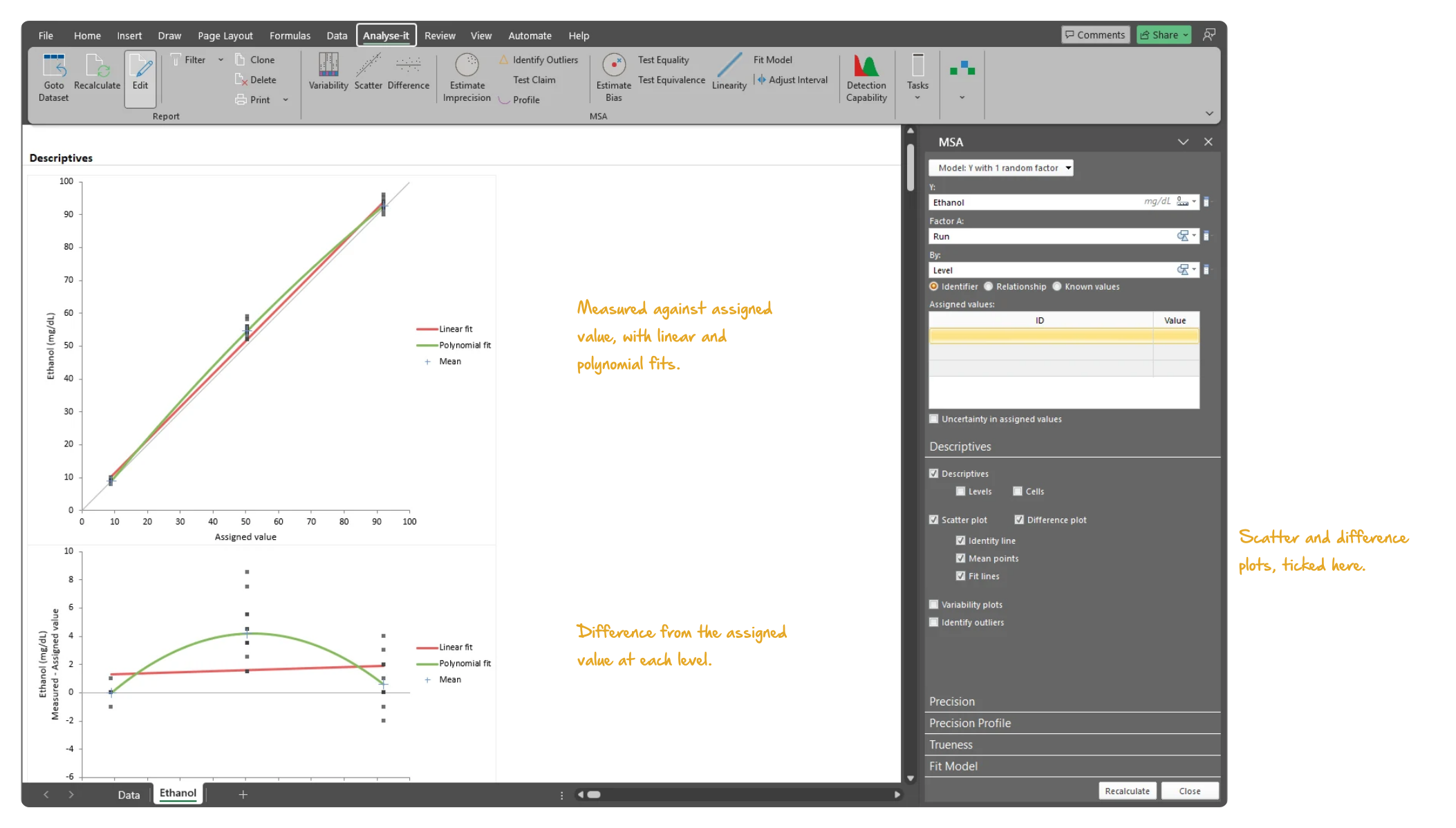
EP10-A3-AMD is the quick check before the full studies: three levels, five runs, three observations. Precision at each level is reported with its confidence interval against the allowable imprecision, and bias at each assigned value against the allowable bias. Any level that fails is flagged. Scatter and difference plots show the measured values against the assigned values with linear and polynomial fits.
Linearity is a question of how far the assay departs from a straight line, and whether that departure is acceptable. Linear and polynomial fits — 2nd to 5th order, forward stepwise, or the best 2nd or 3rd order — show where the assay is linear. Adjust the measuring interval to find the reportable range. The difference between the linear and the nonlinear fit, with Hsieh-Liu confidence intervals, is tested for equality and equivalence against the allowable nonlinearity, such as ±5%. Weighted models handle non-constant precision.
The lowest concentration a procedure can reliably detect, and the lowest it can quantify, need separate estimates. Limit of blank comes from the blank samples, parametric or non-parametric. Limit of detection comes from the pooled SD of the low-level samples, or from probit regression of the detection rate against concentration. Limit of quantitation comes from the precision profile variance function. The precision profile from the EP05-A3 study feeds straight in, with no re-entering of data.
See measurement system analysis results in detail — precision, trueness, linearity and detection capability — using CLSI example datasets you can download and follow along with.
 1 page
EP05-A2 — Appendix B
1 page
EP05-A2 — Appendix B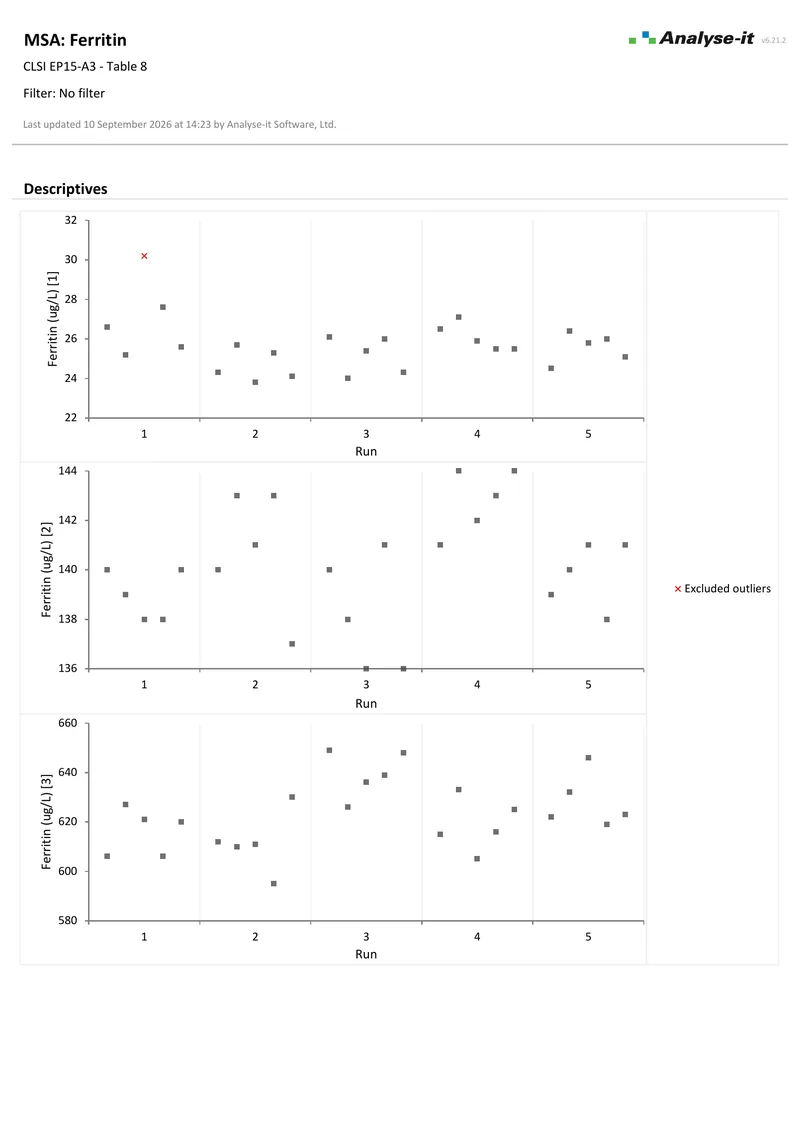 3 pages
EP15-A3 — Table 8
3 pages
EP15-A3 — Table 8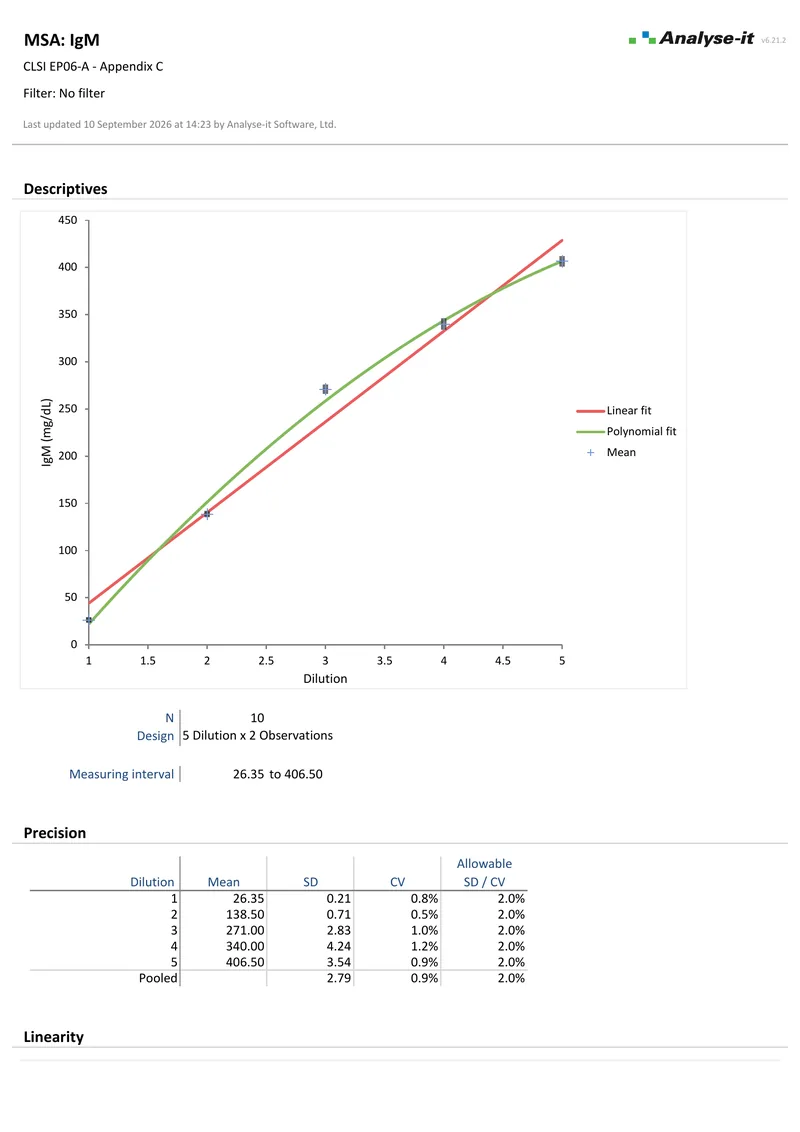 3 pages
EP06-A — Appendix C
3 pages
EP06-A — Appendix C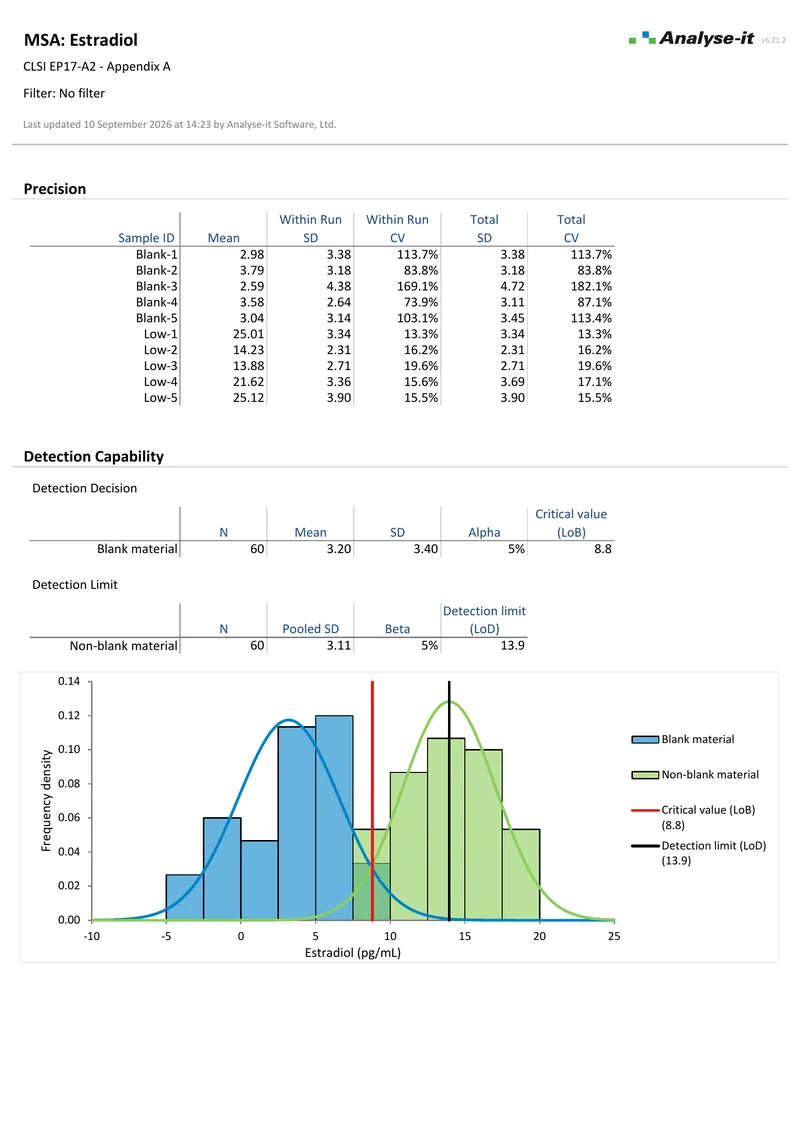 2 pages
EP17-A2 — Appendix A
2 pages
EP17-A2 — Appendix A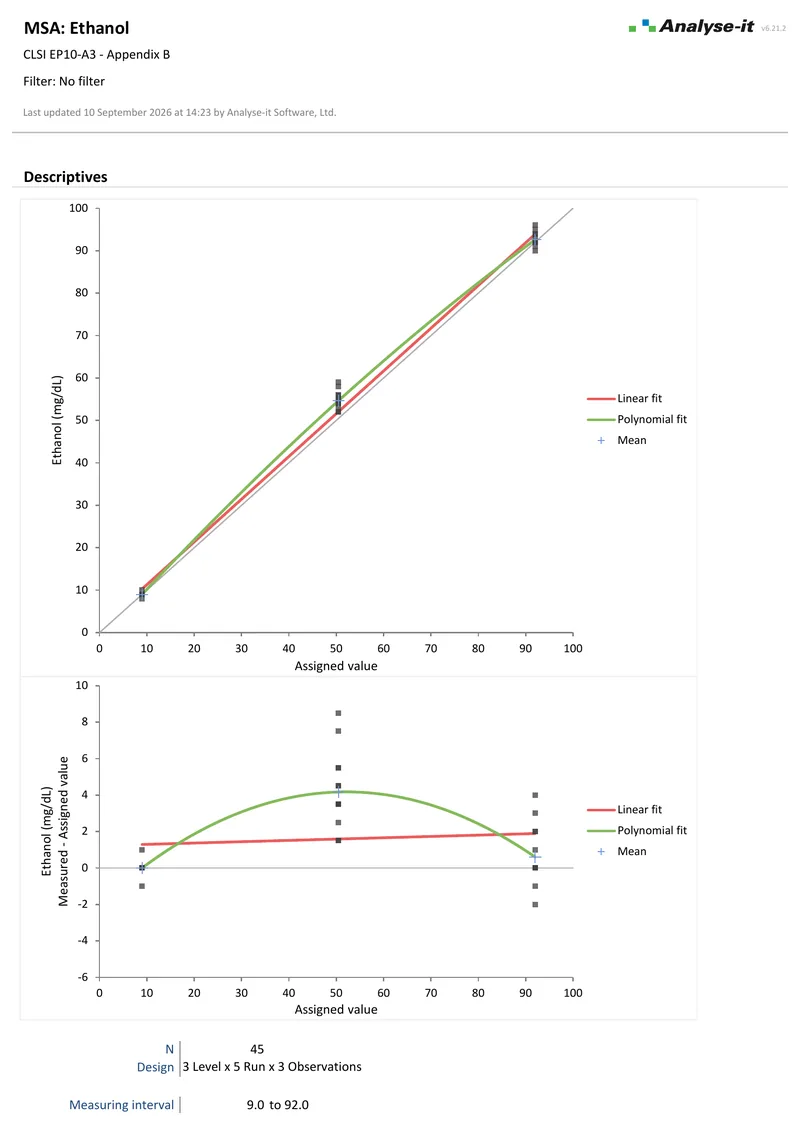 3 pages
EP10-A3 — Appendix B
3 pages
EP10-A3 — Appendix BMeasurement system analysis is one part of the Method Validation edition, alongside method comparison, reference intervals and diagnostic performance.
Related guides in the Learn section: establishing precision, LoB, LoD and LoQ, assessing linearity, rapid method evaluation (EP10) and CAP accreditation and AMR verification.
Try it on your own data first. The 15-day trial is every feature from all five editions, with no sign-up and no licence key — install it and start straight away.
Method Validation edition: US$ 475 per year or US$ 1155 for a perpetual licence. Every purchase carries a 30-day money-back guarantee. Need a quote for purchasing? Add the licence to the cart and save it as a PDF quote.

