Statistical process control that stands up to audit Shewhart, CUSUM, and EWMA control charts with detection rules, process capability analysis with confidence intervals, and Pareto charts for defect prioritisation — plus the full general statistics toolkit for hypothesis testing, ANOVA, and regression. The complete improvement package, inside Excel.

Quality engineers and laboratory managers need control charts that go beyond plotting data against limits — charts with proper detection rules, phases for before-and-after comparison, and stratification to identify contributing sources of variation. They need capability indices that come with confidence intervals and handle non-normal data correctly. And they need the hypothesis tests and regression that the investigation and improvement stages of the workflow require, without switching to a separate tool.

The Quality Control & Improvement edition brings all of this together in one package inside Excel. Control charts, capability analysis, Pareto analysis, and the full Standard edition statistical toolkit — from process monitoring through root cause investigation to sustained improvement. No data leaves your PC. Results stay in standard Excel workbooks that you can share with colleagues, send to auditors, and archive for quality records.

Using Analyse-it we have improved several of our quality control testing steps, better controlled our decision making and are still undergoing process improvements.
Laura Smith
Production manager
The Binding Site

Monitor processes with control charts

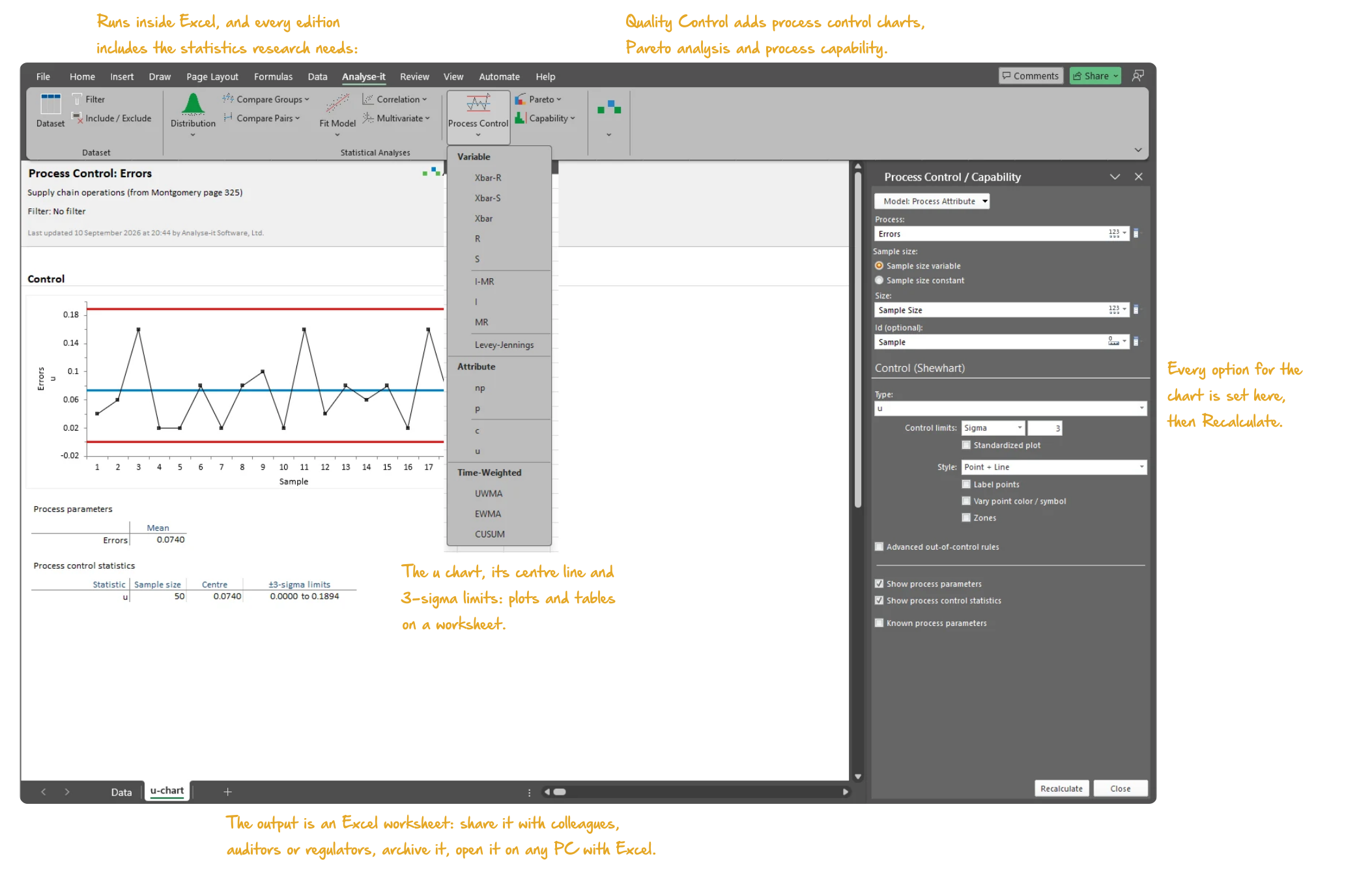
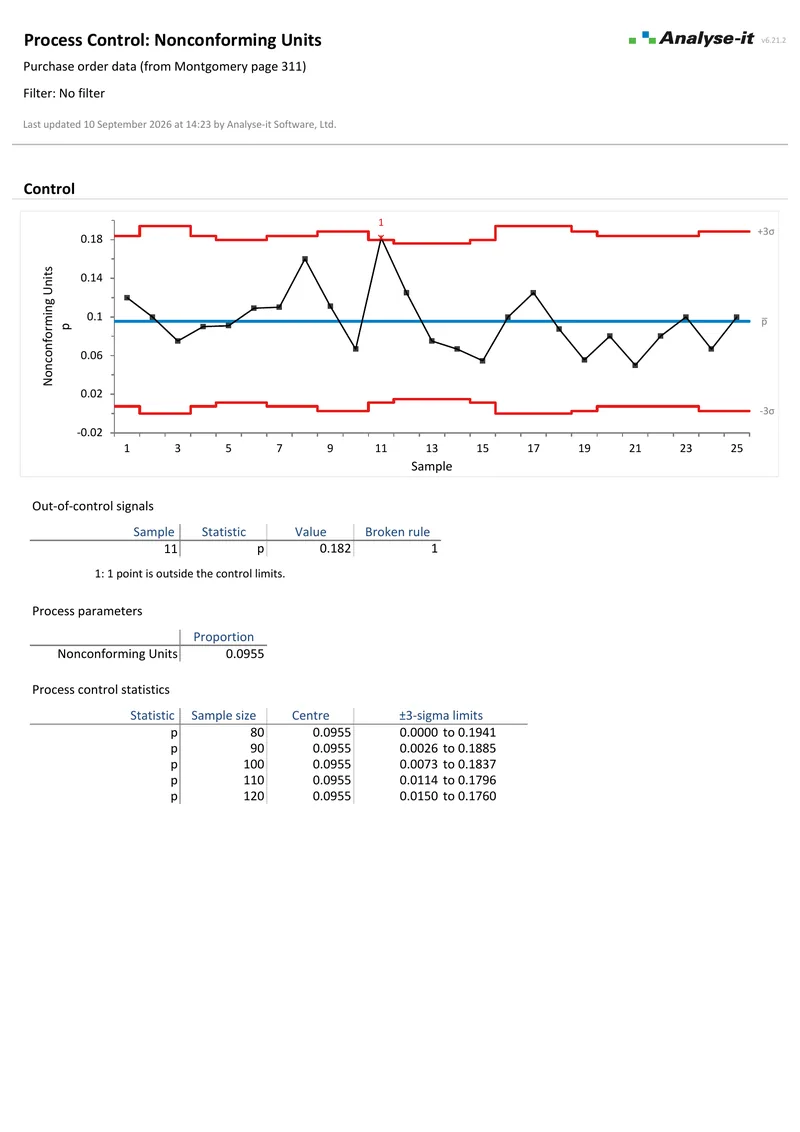
Shewhart variable and attribute charts with automatic detection rules, plus time-weighted charts for detecting small, sustained shifts that Shewhart charts miss:

  • Xbar-R, Xbar-S, I-MR, and individual component charts for continuous data; p, np, c, u for attribute data
  • CUSUM, EWMA, and UWMA time-weighted charts — particularly useful where small drifts accumulate, such as reagent degradation, tool wear, or calibration drift
  • WECO, Nelson, and Montgomery detection rules — runs, trends, stratification, and oscillation flagged automatically
  • Phases for before-and-after comparison with separate control limits per period
  • Stratification by operator, shift, machine, material lot, or any factor
Control chart details →
Shewhart and time-weighted control charts with detection rules

Determine whether the process meets the specification

Capability and performance indices with confidence intervals, non-normal data handling, and the control charts to confirm stability first:

  • Cp, Cpk, Cpm for inherent capability; Pp, Ppk for actual delivered performance
  • Z-benchmark, sigma level, and nonconforming unit estimation (observed %, expected %, expected PPM)
  • Box-Cox and power transformations for non-normal distributions
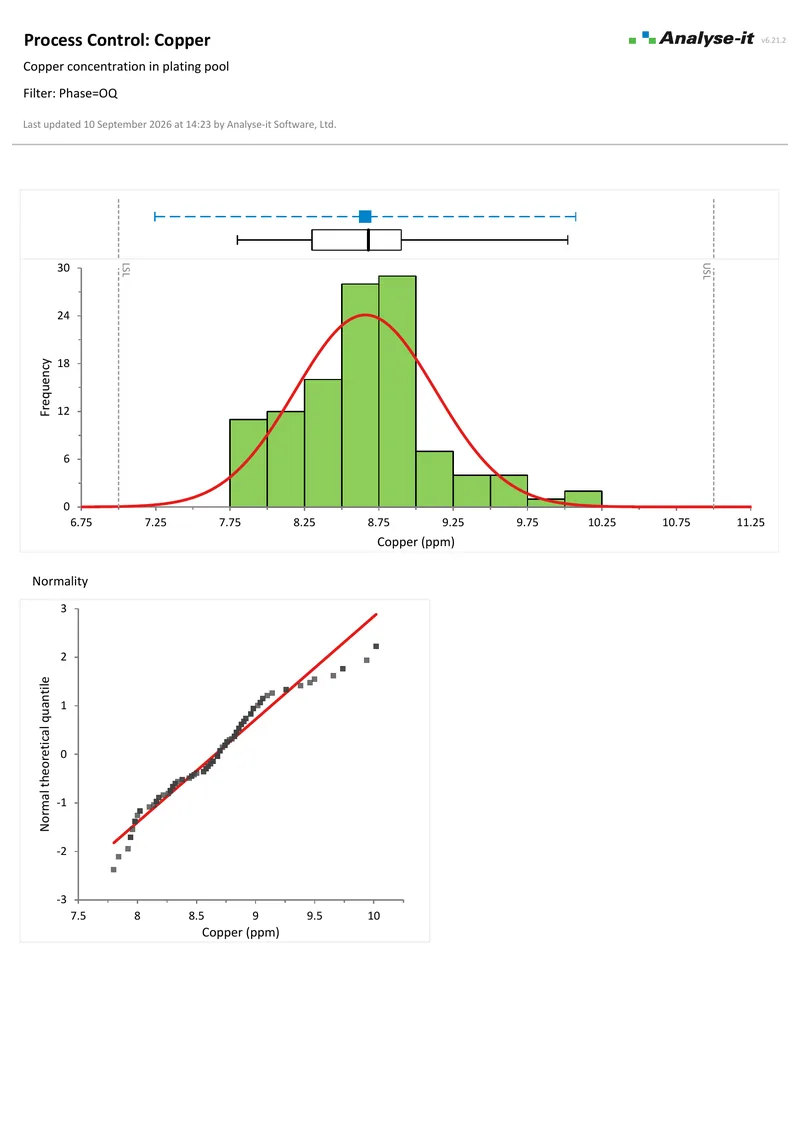
  • Histogram with specification limits and normal Q-Q plot with Lilliefors band
Capability analysis details →
Process capability analysis with histogram and indices

Focus improvement effort on the vital few

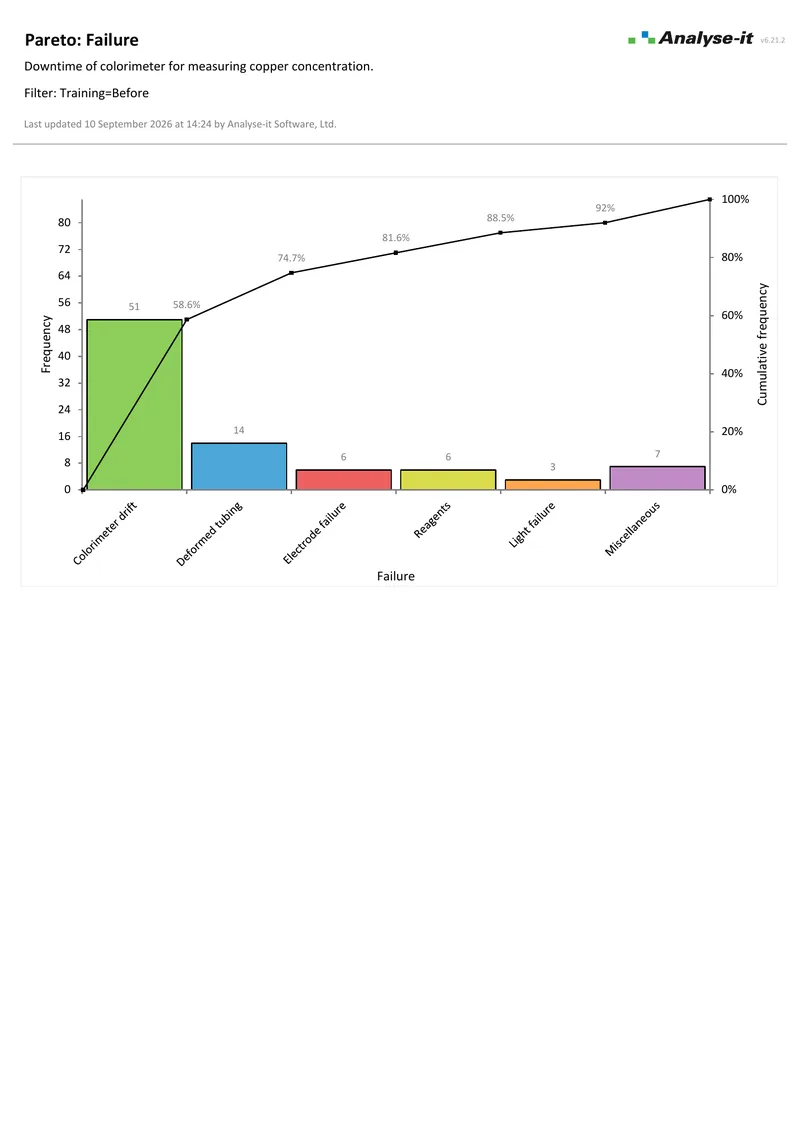
Pareto charts to identify the most frequently occurring defects and break them down by contributing factors:

  • One-way and two-way comparative Pareto charts — defect type by operator, shift, machine, product line
  • Merge low-frequency categories, reorder bars, colour by subgroup
  • 80/20 cumulative percentage line
Pareto analysis details →
Two-way comparative Pareto chart

Confirm root causes and test for differences

When the control chart flags a problem and the Pareto points to a suspect, hypothesis tests and ANOVA confirm whether the difference is real:

  • Student’s t, Welch’s t, Wilcoxon-Mann-Whitney for two groups; one-way ANOVA, Welch’s ANOVA, Kruskal-Wallis for three or more
  • Nine multiple comparison procedures — Tukey-Kramer, Dunnett, Hsu, Scheffé, Steel, Dwass-Steel-Critchlow-Fligner
  • Paired t-test, Wilcoxon signed ranks, within-subjects ANOVA, Friedman
  • Cohen’s d and Hedges’ g effect sizes with non-central t confidence intervals
Hypothesis testing details →
Compare groups with ANOVA and multiple comparisons

Model relationships and quantify improvements

Regression to model the relationship between process inputs and outputs, and ANOVA to quantify the effect of changes:

  • Simple, multiple, polynomial, and logistic regression with full diagnostics
  • ANOVA and ANCOVA with effect means, interaction plots, and multiple comparisons
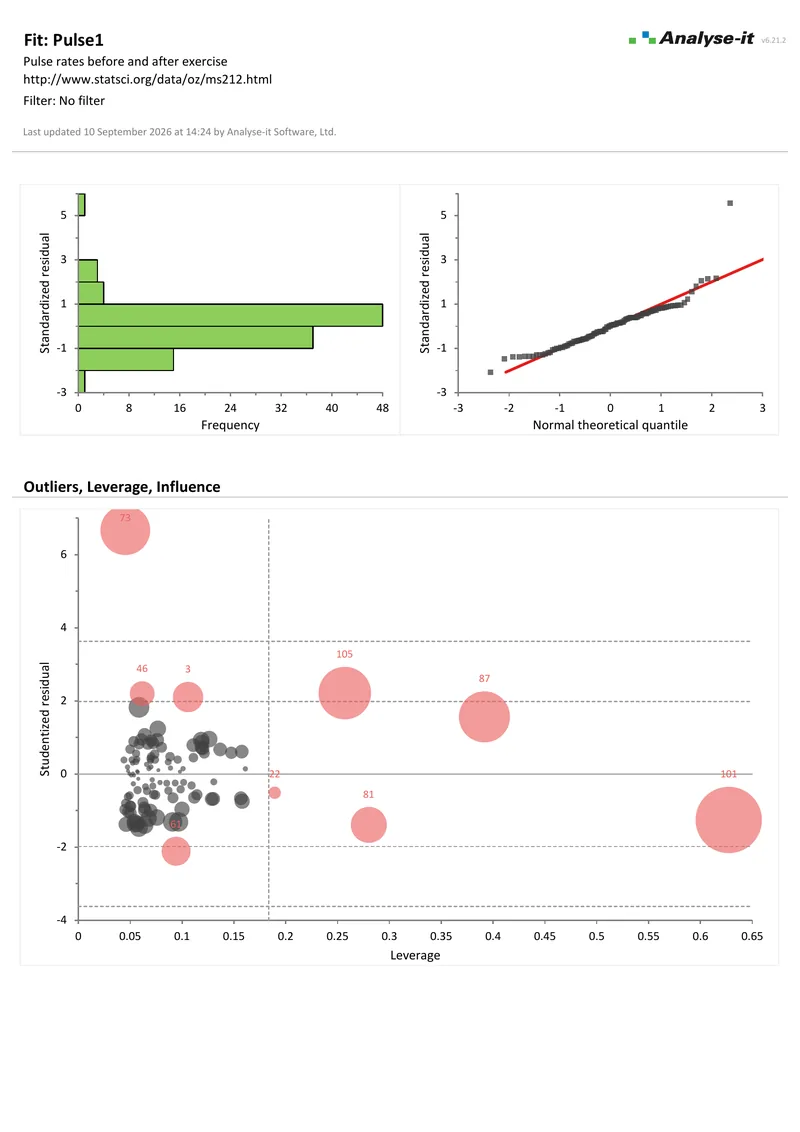
  • Residual diagnostics, leverage plots, Cook’s D influence, VIF for multicollinearity
  • Predicted values from the fitted model
Regression details →
Multiple regression with leverage plots

Describe and understand the data first

Before investigating root causes, understand the distribution:

  • Mean, median, SD, CV%, skewness, kurtosis, geometric mean, quantiles
  • Histograms, box plots, dot plots, Q-Q plots with Lilliefors bands, CDF plots
  • Shapiro-Wilk, Anderson-Darling, and Kolmogorov-Smirnov normality tests
  • Correlation — Pearson r, Spearman rs, Kendall τ with confidence intervals
Descriptive statistics details →
Distribution analysis with histogram and box plot
We have incorporated Analyse-it into our real-time daily QA analysis, making us both more efficient and proactive in addressing QA issues. Analyse-it has saved us time and provides the statistics and professional reports we need.
Dalton Seegert
Medical Technologist QA/Ancillary Testing
Veterans Administration

Includes the full Standard edition

The Quality Control & Improvement edition includes every feature from the Standard edition — the general-purpose statistics toolkit that quality teams use for the investigation and improvement stages of the workflow. Hypothesis tests, ANOVA, regression, descriptive statistics, correlation, contingency tables, PCA, and logistic regression are all in the same workbook as your control charts and capability analyses.


Validated, reliable, trusted for over 30 years

Validated calculations Every statistic tested against published datasets and thousands of internal test-cases. No reliance on Excel’s built-in functions — Analyse-it handles all calculations internally. See how we develop and validate Analyse-it →
Data stays on your PC No cloud processing, no uploads, no third-party access. Your data never leaves your computer — essential when working with proprietary process data, customer specifications, or regulated production records.
Standard Excel workbooks Charts and results are ordinary Excel workbooks. Share with colleagues, send to auditors or customers, archive for quality records — no Analyse-it licence required to view.
No formulas to break Results contain no formulas, so they can’t be accidentally edited or corrupted. The control chart you reported will be exactly what you find when you reopen the workbook.

Example analyses

Download example datasets, open them in the trial, and see exactly what the output looks like.

Control charts — Xbar-R
Copper plating thickness, Montgomery rules.
OQ and production phases, operator stratification, 7 out-of-control signals.
I-MR and attribute charts
Loan costs, supply chain defects, purchase orders.
I-MR chart (3 OOC), u chart for defects per unit, p chart with Z-score.
Process capability
Copper plating thickness with Xbar-R.
Histogram with spec limits, Q-Q plot, Shapiro-Wilk, Pp, Ppk, expected PPM, Z-benchmark.
Comparative Pareto
Colorimeter failures by operator.
Two-way comparative Pareto by operator and training, plus one-way charts.
Compare groups
Y by brand, 7 groups.
One-way ANOVA, Tukey-Kramer all-pairs, Mean-Mean scatter plot.
Multiple regression
Pulse rates, 109 observations, 8 predictors.
VIF, leverage plots, residual diagnostics, outlier/influence plot.

Technical details

Process control

Shewhart variable charts

  • Xbar-R
  • Xbar-S
  • Xbar
  • R
  • S
  • I-MR
  • I
  • MR

Shewhart attribute charts

  • p
  • np
  • c
  • u

Time-weighted charts

  • CUSUM (cumulative sum)
  • EWMA (exponentially weighted moving average)
  • UWMA (uniformly weighted moving average)

Detection rules

  • WECO rules
  • Nelson rules
  • Montgomery rules
  • Custom rules

Chart features

  • Phases with separate control limits per period
  • Stratification by any factor (colour points)
  • Label out-of-control points
  • Control limits from data or specified standard
  • Plot styles: point, line, high-low, box plot

Process capability

Capability indices

  • Cp, Cpl, Cpu, Cpk
  • Cpm
  • All with confidence intervals

Performance indices

  • Pp, Ppl, Ppu, Ppk
  • All with confidence intervals

Yield and sigma

  • Z-benchmark (short-term and long-term)
  • Sigma level
  • Nonconforming units — observed %, expected %, expected PPM

Distribution assessment

  • Histogram with specification limits
  • Normal Q-Q plot with Lilliefors confidence band
  • Box-Cox and other power transformations

Pareto analysis

  • Pareto chart with cumulative percentage line
  • 1-way comparative Pareto chart
  • 2-way comparative Pareto chart
  • Merge bars to reduce clutter of small-frequency categories
  • Reorder bars to highlight specific problems
  • Vary colour of bars to distinguish categories or subgroups

Included from the Standard edition

The Quality Control & Improvement edition includes every feature from the Standard edition. See the Standard edition page for the full technical specification, including:

  • Descriptive statistics, histograms, box plots, dot plots, Q-Q plots, normality tests
  • Compare groups: t-test, Welch, Wilcoxon, ANOVA, Kruskal-Wallis, 9 multiple comparison procedures
  • Compare pairs: paired t-test, Wilcoxon signed ranks, Friedman, within-subject ANOVA
  • Effect sizes: Cohen’s d, Hedges’ g, Hodges–Lehmann
  • Contingency tables: Pearson χ², Fisher exact, McNemar, odds/risk ratios
  • Simple, multiple, polynomial, logistic regression with diagnostics
  • ANOVA/ANCOVA with effect means, interaction plots, multiple comparisons new in v4.80
  • Correlation: Pearson r, Spearman rs, Kendall τ
  • PCA, common factor analysis, biplots, 12 rotation methods
  • Cronbach’s alpha new in v4.80

System requirements

  • Microsoft Excel 2013, 2016, 2019, 2021, 2024 and Microsoft 365 for Microsoft Windows (32- and 64-bit)
  • Microsoft Windows 8, 10, 11, Server 2016, 2019, 2022
  • 2 GB RAM minimum recommended
  • 80 MB disk space