Reference Range and Reference Interval Software for Clinical Laboratories
The complete, validated implementation of CLSI EP28-A3C — establish, partition, and verify reference intervals for any analyte, any population, and any distribution, all within Excel.
Try free for 15 days — no credit card required
Trusted by 75,000 scientists at most of the top-10 IVD manufacturers, and at thousands of ISO 15189, ISO/IEC 17025, and CLIA-regulated laboratories worldwide for over 30 years.
Every method EP28-A3C requires
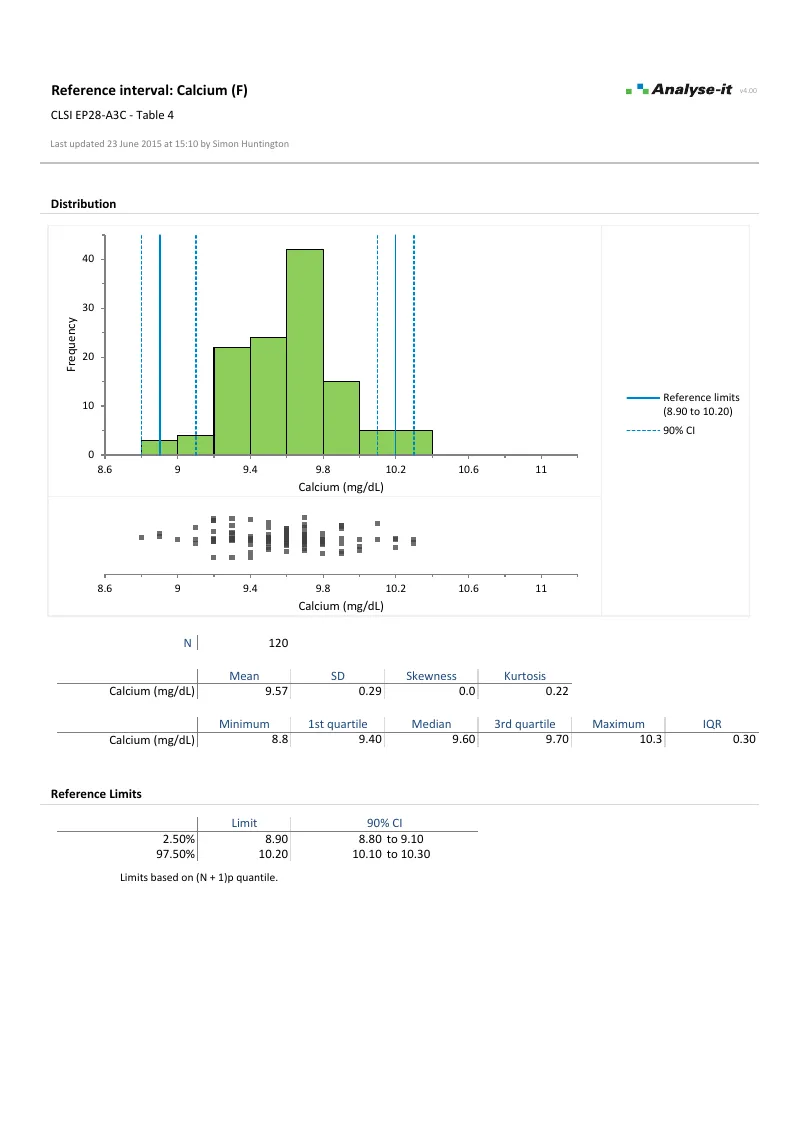
Parametric, non-parametric, robust, bootstrap, and Harrell-Davis quantile methods — all in one package. Choose the method that fits your data and population, not the one your software happens to support.
Results you can stand behind
Every calculation runs in Analyse-it’s own validated engine — no Excel formulas, no third-party functions. Validated against CLSI EP28-A3C reference datasets before every release. Defensible in a CAP inspection, ISO 15189 audit, or FDA 510(k) submission.
Your data never leaves your environment
Analyse-it runs entirely on your PC. Nothing is sent to a server, nothing is exposed to a cloud service - important when working with pre-submission or patient-adjacent data under data governance constraints.
Establishing reference intervals is rarely straightforward. Real patient populations aren’t always normally distributed. Clinically meaningful differences between sex, age groups, or ethnicity mean a single interval often isn’t appropriate. Sample sizes are frequently smaller than EP28-A3C ideally requires, which puts pressure on your choice of statistical method. And once intervals are established, transferring them to a new measurement procedure — or verifying that a manufacturer’s published intervals are applicable to your patient population — adds another layer of statistical complexity.
Analyse-it handles all of it. Parametric methods when your data supports the normality assumption, non-parametric and robust methods when it doesn’t, bootstrap and Harrell-Davis quantile methods for smaller samples. A full range of transformations — log, square root, Box-Cox, Manly, and 2-stage exponential/modulus — to bring non-normal distributions into line before applying parametric approaches. Partitioning by any clinically relevant factor so that intervals for different subgroups are derived from the right data. And transfer and verification procedures so you can confirm existing intervals are fit for your laboratory and your population.
Every method follows CLSI EP28-A3C. Every calculation runs in Analyse-it’s own validated engine — not in Excel formulas that can silently break. Results are validated against the example datasets published in the guidelines before every release, so the intervals you report are the intervals you can defend.
Seen in the field
What's included
-
Parametric and non-parametric methods
Establish reference limits using normal quantile methods when your data supports the normality assumption, or non-parametric quantile methods when it doesn’t. Multiple quantile computation methods supported — (N+1)p, Np+½, and (N+⅓)p+⅓ — so you can match the approach to your protocol requirements.
-
Robust and bootstrap methods for smaller samples
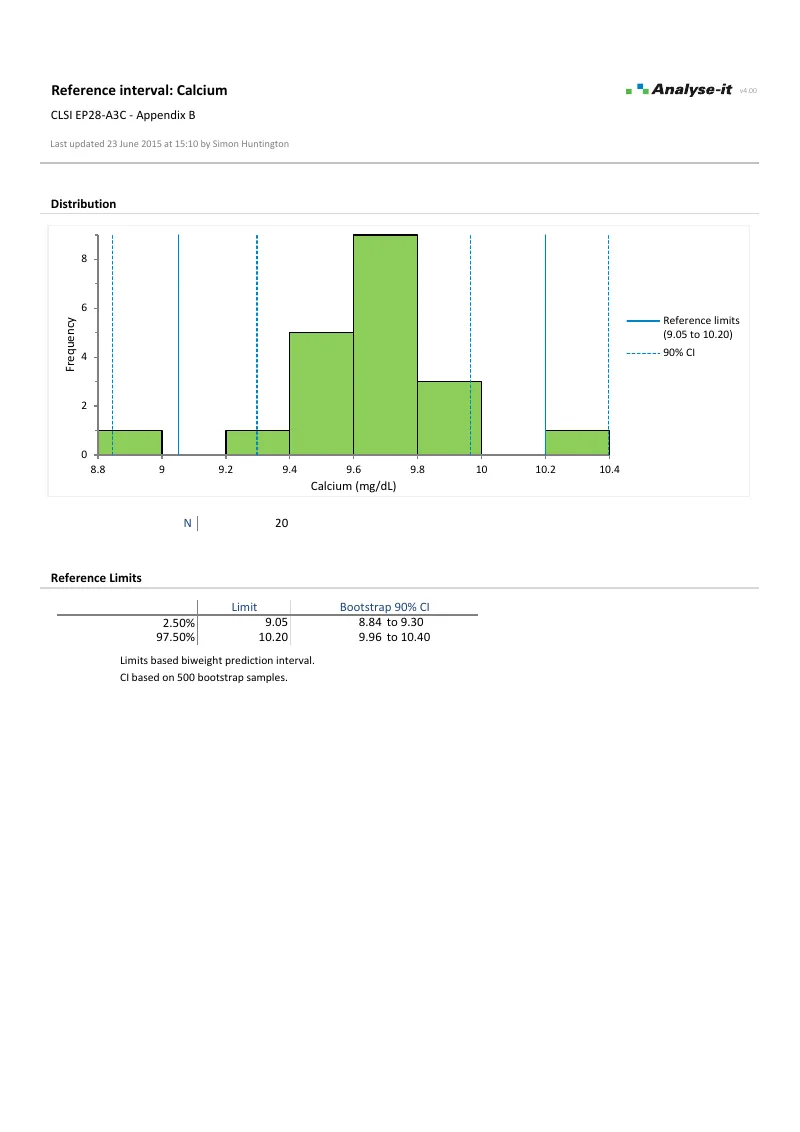
Robust bi-weight quantile methods for symmetric and skewed distributions when sample sizes are smaller than EP28-A3C ideally requires. Bootstrap and Harrell-Davis quantile methods for additional flexibility. Confidence intervals included for all limit estimates.
-
Transformations for non-normal distributions
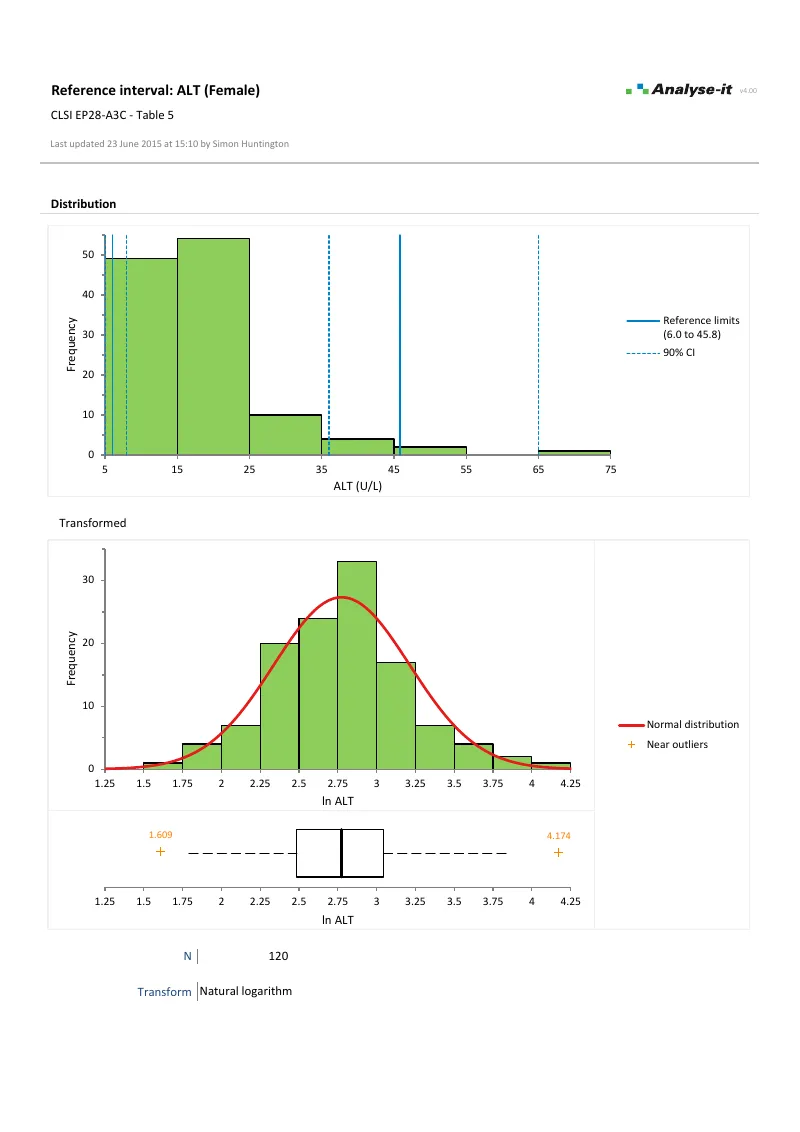
Log, square root, reciprocal, Box-Cox, Manly exponential, and 2-stage exponential/modulus transformations to bring non-normal data into line before applying parametric methods. Shapiro-Wilk and Anderson-Darling normality tests and normal Q-Q plots to assess the distribution before and after transformation.
-
Partitioning by clinically relevant factors
Derive separate reference intervals for sex, age group, ethnicity, or any combination of factors where biological differences make a single interval clinically inappropriate. Partition by any number of subgroups within a single analysis.
-
Outlier identification
Tukey outlier box plots and formal outlier tests to identify values that should be excluded from the reference population before limits are established — following the EP28-A3C approach to reference sample screening.
-
Transfer and verification of existing intervals
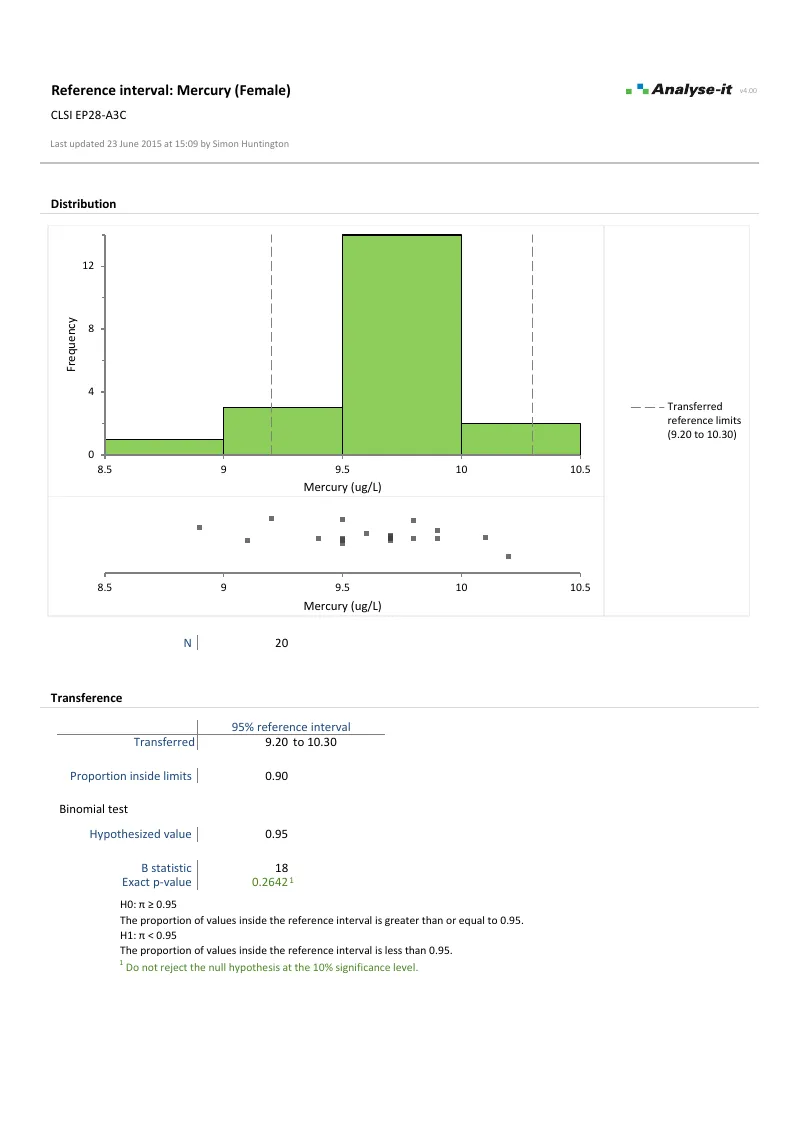
Verify whether published or manufacturer-provided reference intervals are transferable to your laboratory and patient population using the binomial test for proportion inside the reference interval. Transfer existing intervals to a new measurement procedure using method comparison regression, without repeating a full reference population study.
-
Publication-ready reports
Generate clean, formatted reports directly from your analysis. No reformatting, no copy-paste errors, no additional tools required — whether the output is going into a laboratory validation file, a regulatory dossier, or a published study.
-
Validated before every release
Every calculation is performed by Analyse-it’s own engine — no Excel formulas or functions. Results are validated against the example datasets in the CLSI EP28-A3C guidelines before every release, so you can trust what you’re signing off on. See our development and validation process →
-
Your data never leaves your environment
Analyse-it runs locally on your PC. No cloud processing, no data transmission, no exposure risk — your patient sample data stays where it belongs.
-
More than just reference intervals
Reference intervals are one part of a complete method validation workflow. The Method Validation edition also covers measurement system analysis (EP05, EP06, EP15, EP17), method comparison (EP09), diagnostic performance (EP24, EP12), and total analytical error (EP21). One validated package for everything your laboratory or IVD submission requires.
-
We use Analyse-it frequently for our verification and pre-verification work, in accordance with CLSI guidelines for in-vitro diagnostics. It's saved time and effort compared to the hodge-podge of applications we used before, JMP, SAS, etc...Brian Noland, Ph.D.Principal Scientist, Product DevelopmentBiosite / Inverness Medical Innovations
-
We use Analyse-it for the analysis of data necessary to file 510k. We chose Analyse-it because it works in Excel, includes CLSI protocols, and, unlike EP-Evaluator, lets us analyze data directly from equipment without typing.Thomas D Harrigan, Ph.D.Technical Product ManagerAlfa Wassermann Diagnostic Technologies
-
I used Analyse-It for many product development, product troubleshooting, and technology evaluation activities... your product was the easiest to use, was accurate, and produced publication ready reports.Stanley F. Cernosek, Ph.D.Clinical Chemistry Reagent DevelopmentBeckman Coulter, Inc.
-
Analyse-it has been a tremendous help. I've published and presented at national cardiology meetings and couldn't have accomplished most of my research without it. Using Analyse-it, I even found errors or omissions in the work of our statistician!Regina S. Druz, MD, FACC, FASNCDirector, Nuclear CardiologyNorth Shore University Hospital
-
Although we only scratch the surface of Analyse-it’s capabilities, we have a very high volume of use for the statistics we need. It’s saved us time and the reports look professional.Michael SavageChemistry SupervisorBaptist Hospital East
Join 75,000 scientists who rely on Analyse-it. No credit card required. Full functionality from day one.
Try free for 15 days — no credit card required