Every feature from all five editions for 15 days.
Method Validation edition from US$ 475 a year · 30-day money-back guarantee.
Excel’s scatter chart and trendline show the average relationship between two measurement procedures and stop. A regression line does not show the individual differences, whether they stay constant or widen at higher concentrations, or whether a single patient result could be misclassified. The difference plot shows all of that, which is why Bland-Altman is the standard way to visualise and quantify agreement in clinical laboratories, IVD development and published research.
Is the bias constant across the measuring range, or does it scale with concentration? Do the limits of agreement fall inside the allowable difference, and how certain are the limits themselves? Do replicate measurements, or a measuring range that has to be partitioned, change the answer? Each changes what the limits of agreement mean.
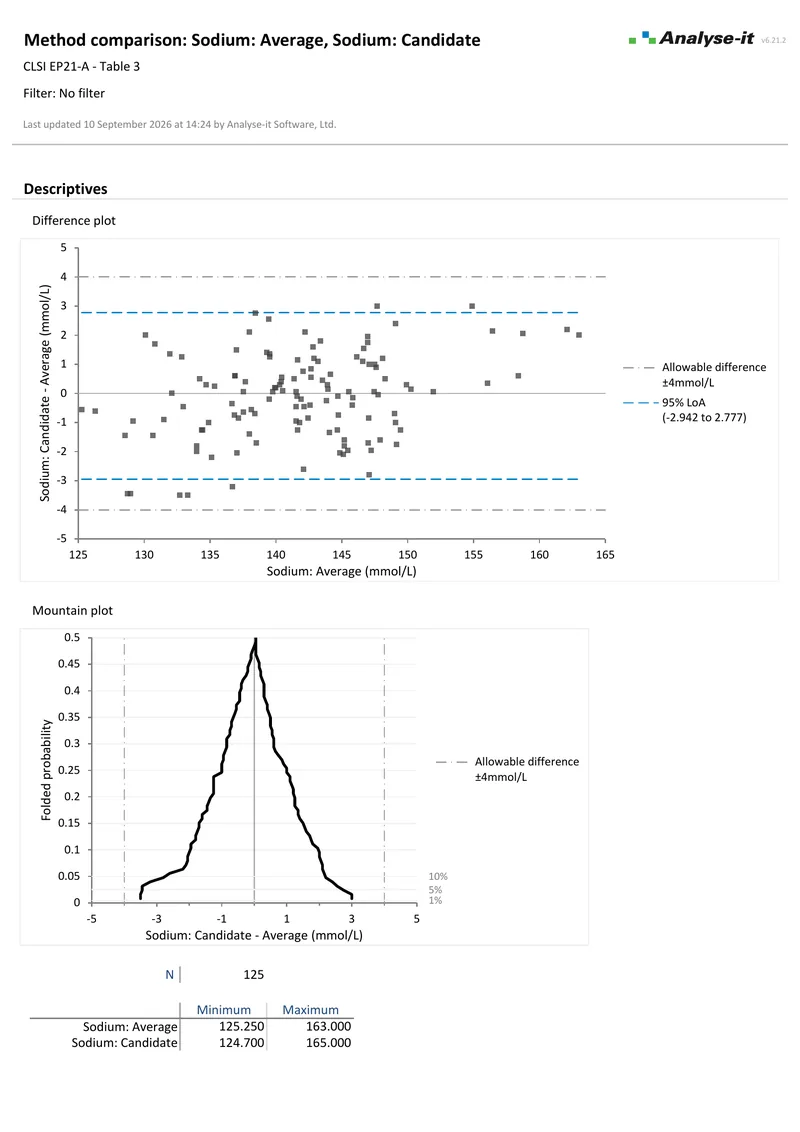
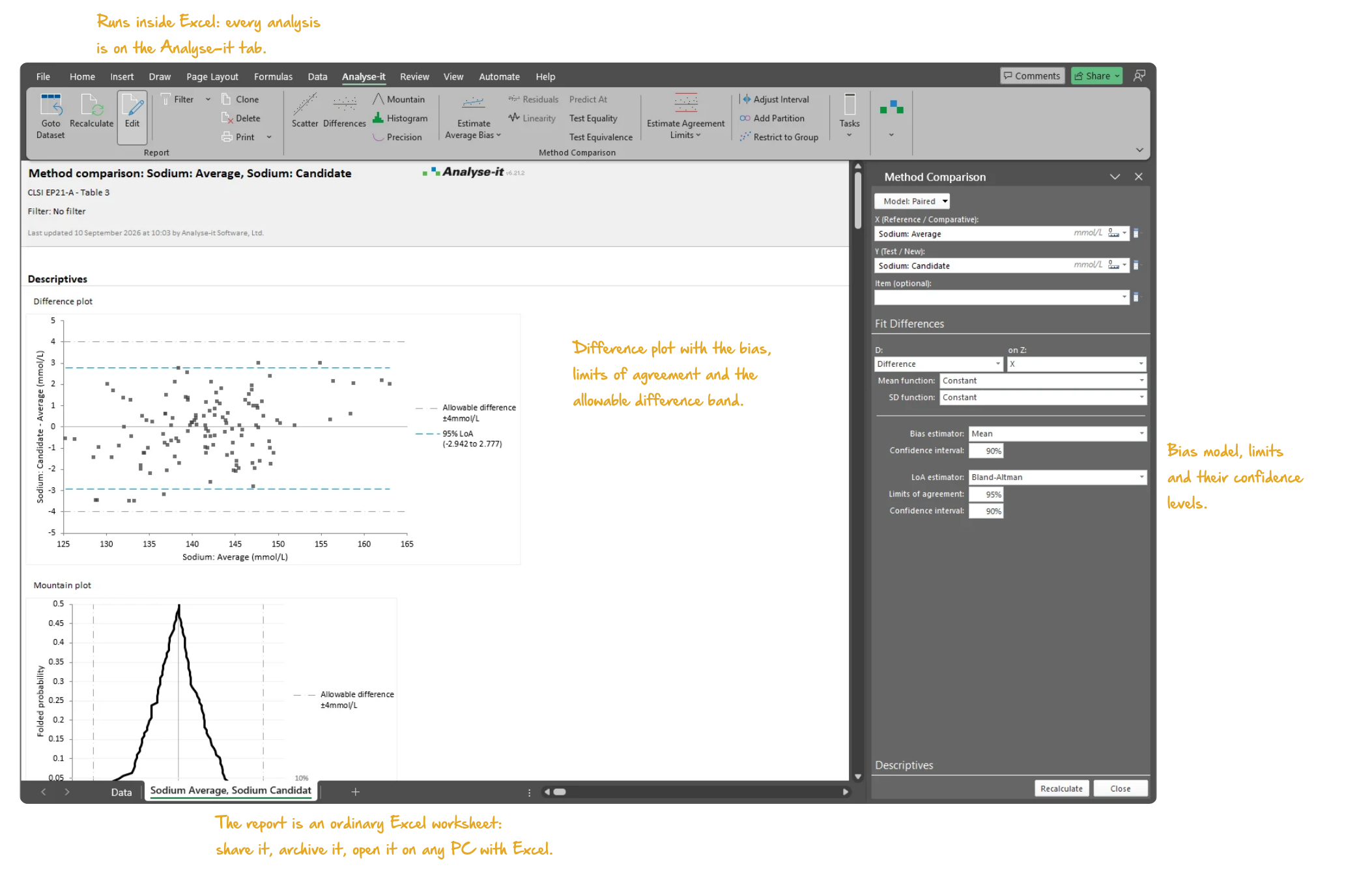
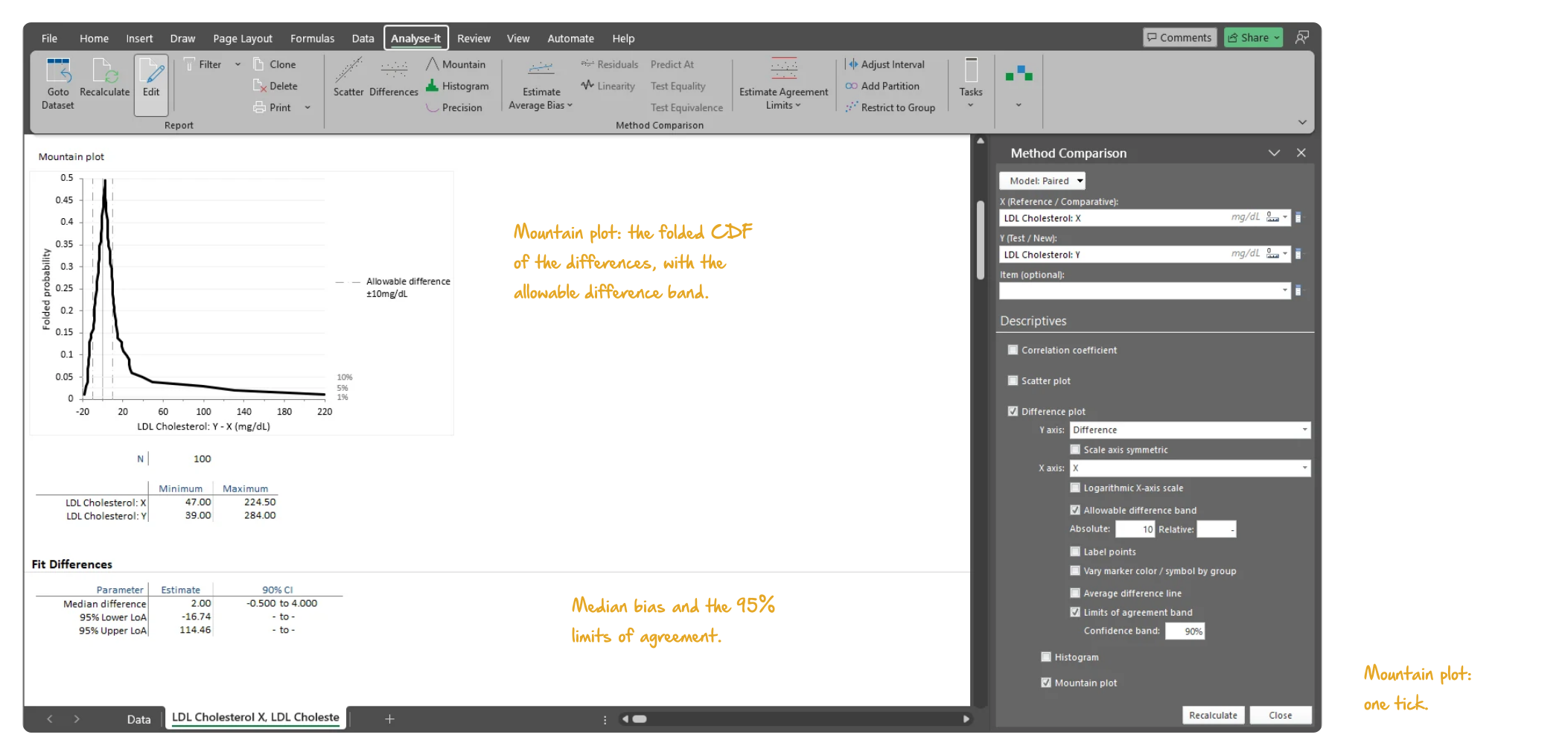
Every difference across the measuring range on one plot: the differences against the best estimate of the true value. The bias, the limits of agreement and the allowable difference band are overlaid. Specify the allowable difference as an absolute value, a percentage or a combination: “±4 mmol/L”, or “10%, with a minimum of 5 mg/dL”. The band shows whether agreement is inside clinically acceptable limits. Plot the difference, the relative difference or the ratio, with a histogram of the differences. The mountain plot alongside shows the cumulative distribution of the differences, with the same allowable difference band, for a second view of agreement.
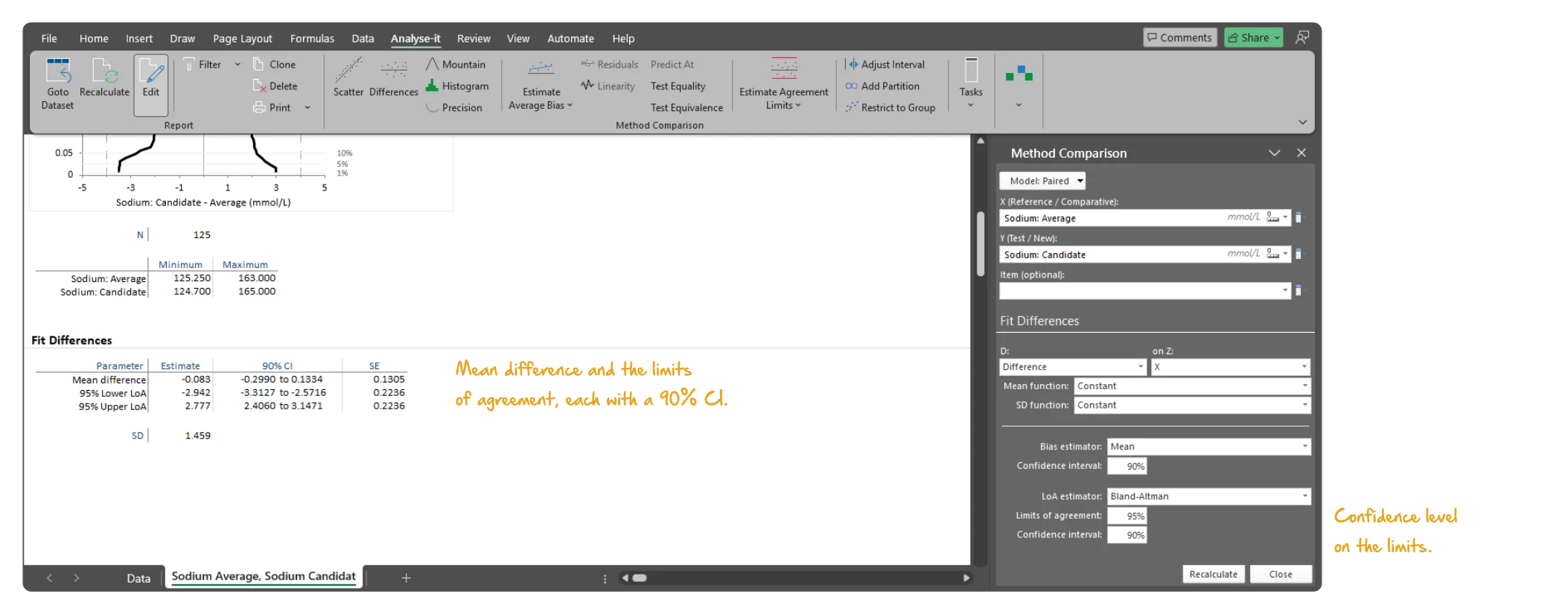
Three bias models in one analysis, so the limits match the structure of the differences. Mean bias for centred, symmetric differences. Median bias for skewed distributions. Linear fit when the bias scales with concentration. Horizontal limits of agreement when precision is constant across the range, or V-shaped limits that widen in proportion when it is not. Non-parametric limits when the differences are not normally distributed. Compare all three on the same data and choose the one that represents the relationship.
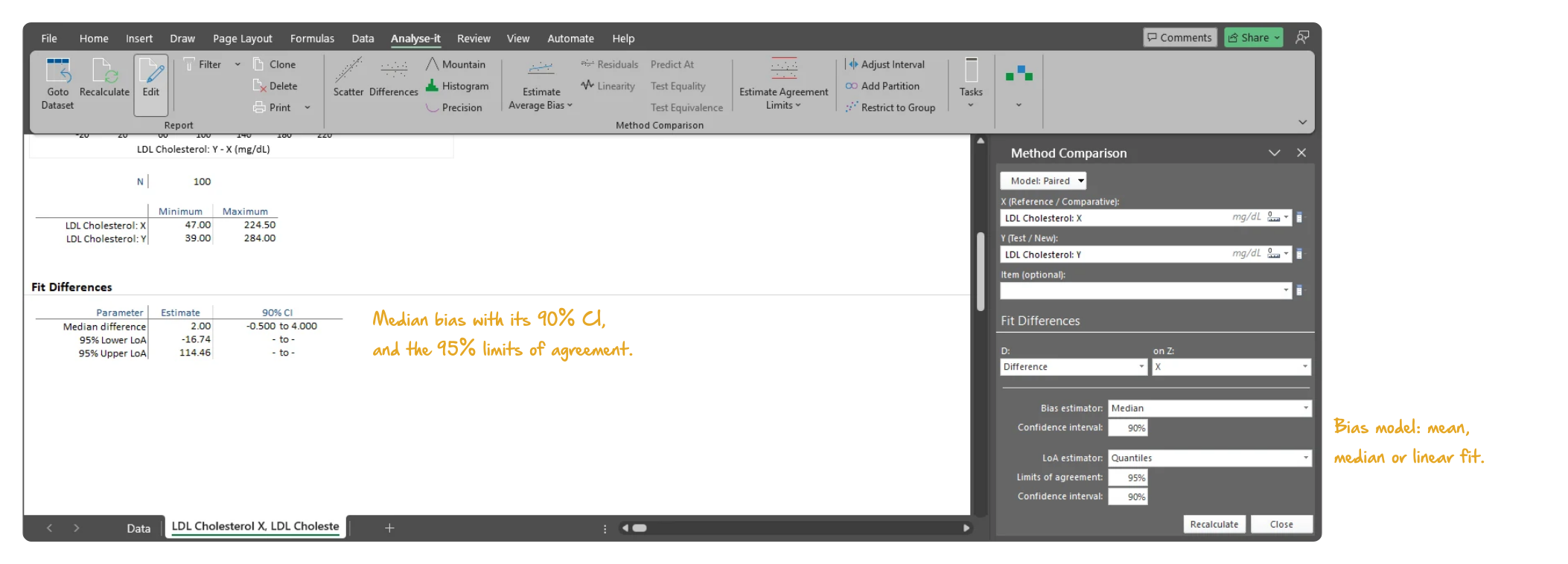
A limit of agreement is an estimate, and its uncertainty matters most when the limit sits close to the allowable difference. Confidence intervals are reported on the bias and on the upper and lower limits of agreement. The intervals give the uncertainty in the agreement boundary, not only in the central estimate.
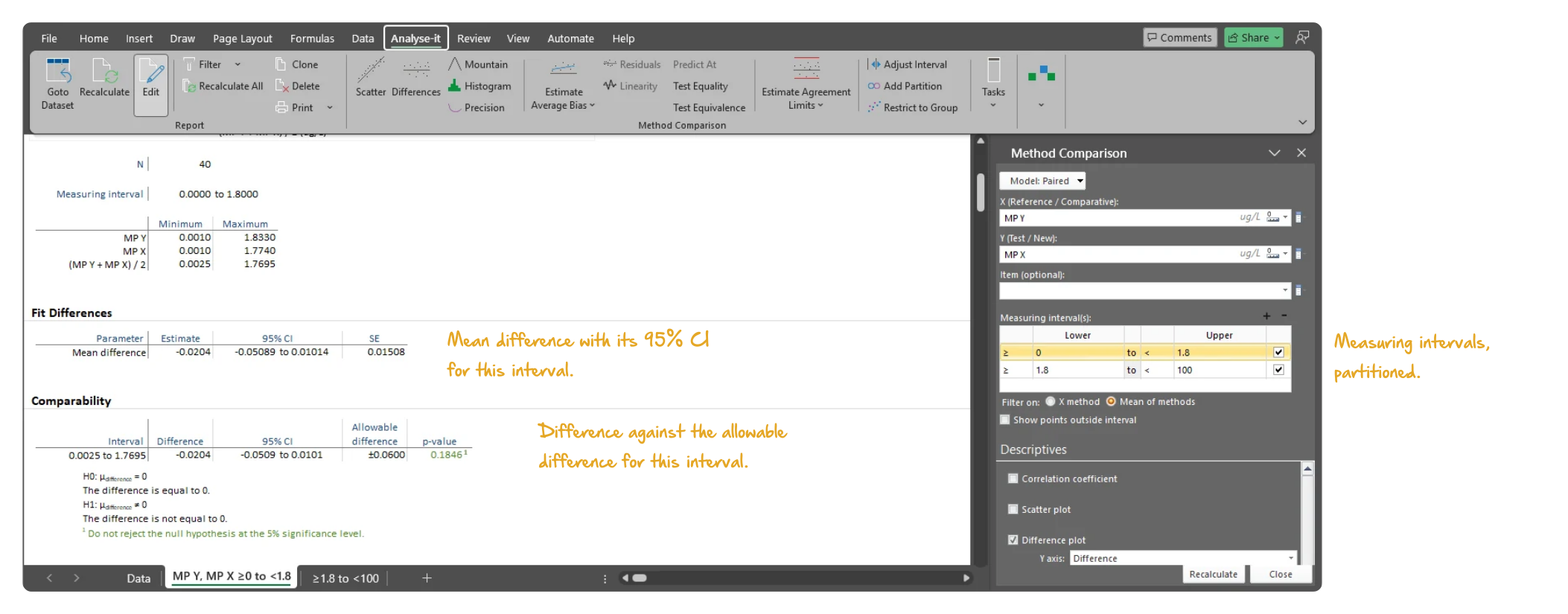
Precision that changes across the measuring range, or a clinical threshold with a different requirement either side of it, is not served by one set of limits. Partition the data into separate measuring intervals, each with its own bias estimate, limits of agreement and allowable difference assessment. The allowable difference can be ±0.06 μg/L below the threshold and ±6% above it, for example. Use any fit within each interval, as EP09-A3 specifies, or reduce the measuring interval to the range the comparison supports.
Averaging replicates before the analysis hides the within-subject variation and narrows the limits. Measure in singlicate, duplicate or any number of replicates. Within-subject variation is estimated directly from the replicate structure and the limits of agreement adjusted accordingly, not approximated by averaging.
See Bland-Altman results in detail — difference plots, limits of agreement, mountain plots and allowable difference bands — using CLSI example datasets you can download and follow along with.
 2 pages
EP09-A3 — Appendix I
2 pages
EP09-A3 — Appendix IBland-Altman sits alongside the five regression methods in the method comparison analysis. For a regression-based bias estimate, see Passing-Bablok for a non-parametric approach or Deming and Weighted Deming for a parametric approach.
Related guides in the Learn section: Bland-Altman limits of agreement explained, why correlation is the wrong statistic, choosing a regression and comparing instruments within one laboratory.
Bland-Altman agreement is also in the Medical edition, with diagnostic accuracy, reference intervals and survival analysis. For clinical and biomedical research it is the better fit, from US$ 340 a year. The Method Validation edition adds precision, linearity, detection limits and regression-based method comparison for validating a method.
Try it on your own data first. The 15-day trial is every feature from all five editions — install it and start straight away.
Method Validation edition: US$ 475 per year or US$ 1155 for a perpetual licence. Every purchase carries a 30-day money-back guarantee. Need a quote for purchasing? Choose the licence on the pricing page and click Get a quote.