Every feature from all five editions for 15 days.
Method Validation edition from US$ 475 a year · 30-day money-back guarantee.
Excel’s STDEV and PERCENTILE functions give the SD or a quantile of a set of blank results and stop. No limit of detection from the low-level samples, no variance function fitted to a precision profile, no probit regression. No plot of the blank and low-level distributions against the limits. Low-concentration results drive clinical decisions — ruling out disease, screening, monitoring drug levels. A measurement procedure that cannot reliably separate a true signal from blank noise reports false positives or misses genuine low-level results. Set the limits too high and genuine low results go unreported; set them too low and confidence in the assay is lost.
Where does blank noise end? What is the lowest concentration the procedure reliably detects? Where is the measurement uncertainty small enough for the result to be clinically actionable? EP17-A2 defines the framework: LoB, LoD and LoQ. Analyse-it covers the full EP17-A2 workflow, with more than one estimation approach for the LoB and LoD. Precision profiles from EP05-A3 studies feed directly into the variance function methods — no re-entering of data, no separate tools for LoB, LoD and LoQ.
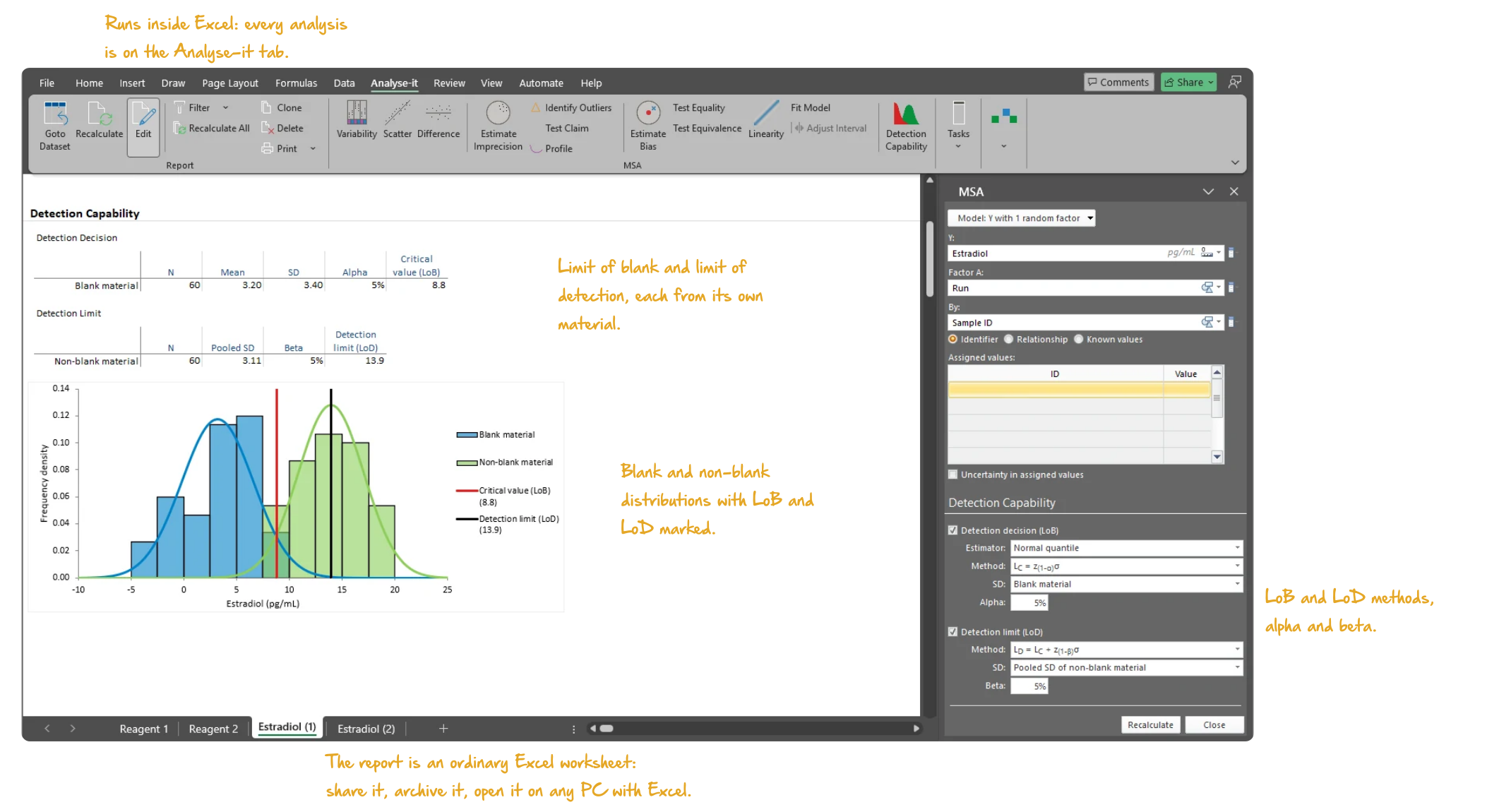
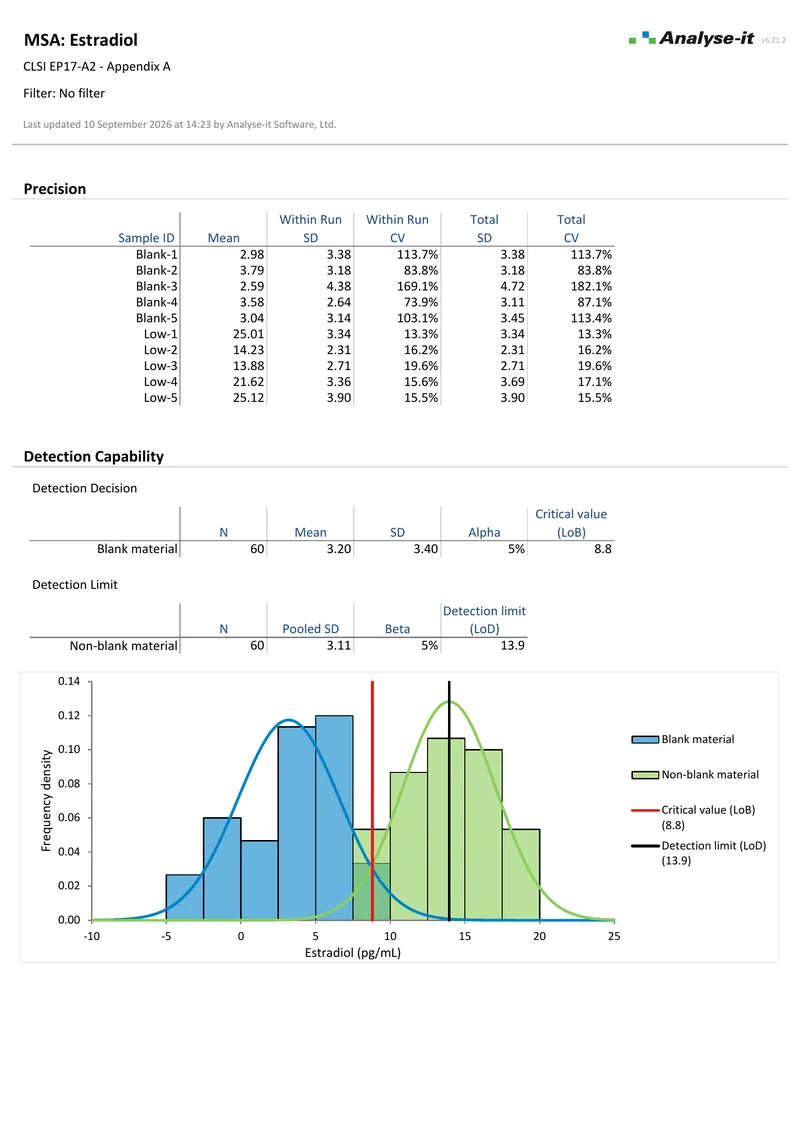
The limit of blank is the noise floor: the highest result expected from a sample that contains no analyte. Estimate it parametrically from the SD of the blank measurements, or non-parametrically from their quantile. The blank and low-level replicates of an EP17-A2 study go straight into the analysis. The same design fitted to a second reagent lot gives that lot its own limits.
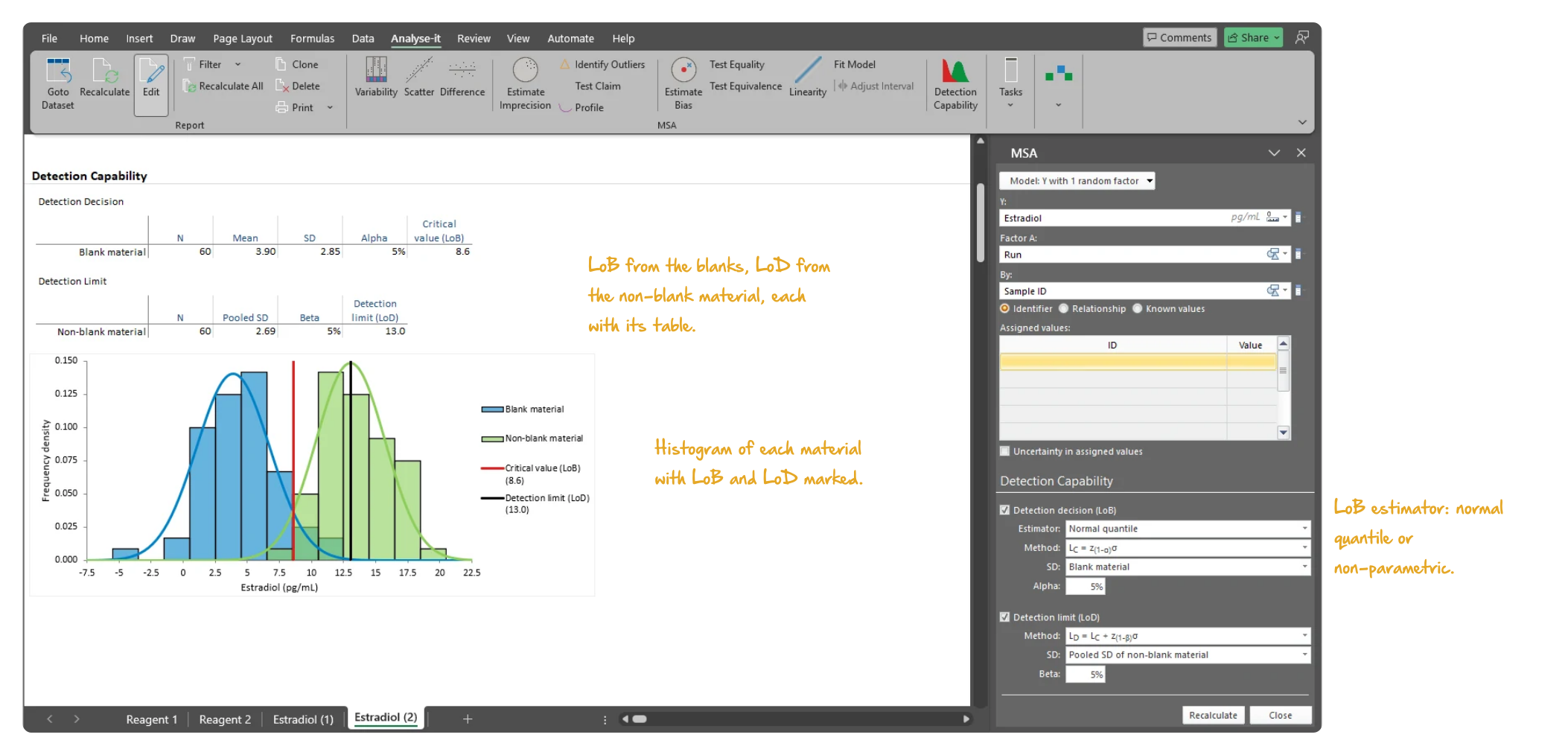
The limit of detection is the lowest concentration reliably distinguished from blank. Following EP17-A2, the LoD comes from the LoB and the pooled SD of the non-blank, low-level materials. The frequency density histogram overlays the blank and low-level distributions with the LoB and LoD lines. The separation between blank noise and true signal is then visible, not only tabulated.
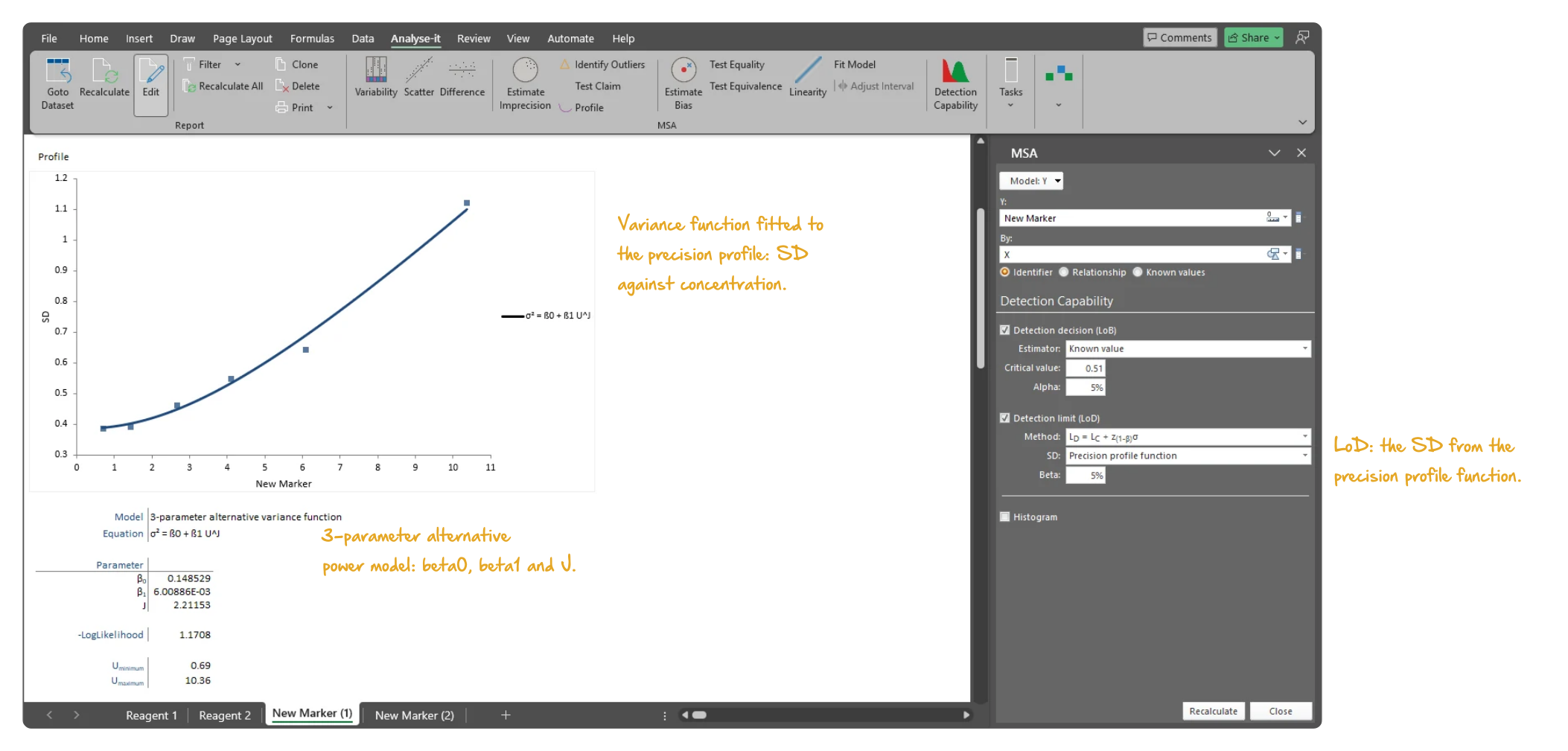
When an EP05-A3 precision study already covers the low end of the measuring range, the detection limits come from it and no separate blank study is needed. One of seven variance functions — constant, mixed constant/proportional, the 3-parameter alternative power model and others — is fitted to the precision profile. The LoB and LoD are read from the fitted function. The same precision data then supports both the precision claim and the detection capability claim.
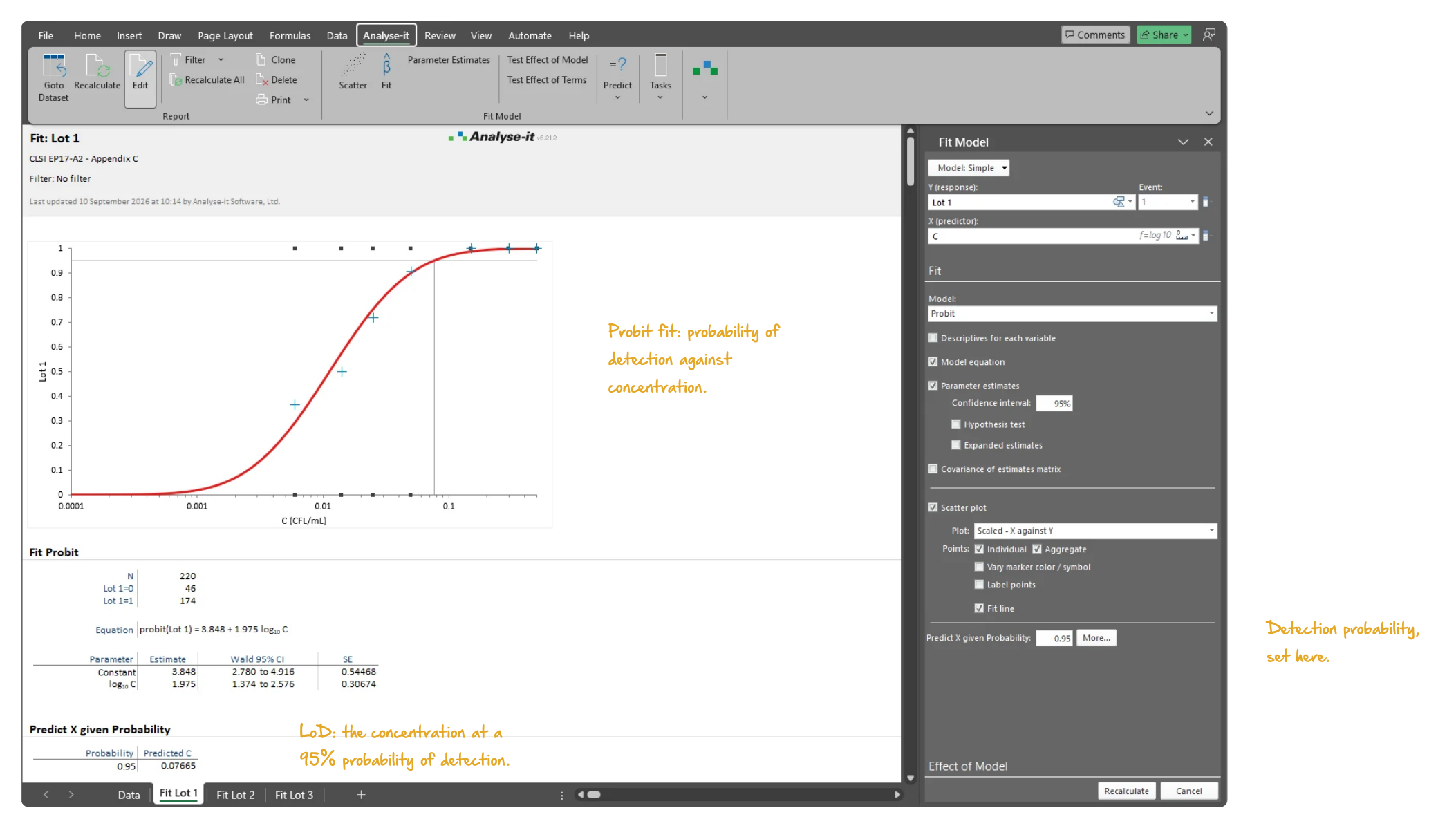
For molecular and immunoassay methods where each result is detected or not detected, detection is probabilistic. Probit regression fits the detection rate against concentration across a dilution series. The LoD is the concentration at which the probability of detection reaches the required threshold, such as 95%. Fit each reagent lot separately, as EP17-A2 Appendix C does.
The limit of quantitation is where a result becomes a number worth reporting, not only a detection. The LoQ is the concentration at which imprecision drops below the threshold for clinically reliable quantitative results, such as a CV of 10% or 20%. The estimate comes directly from the precision profile variance function. The analysis takes the EP05-A3 precision data directly.
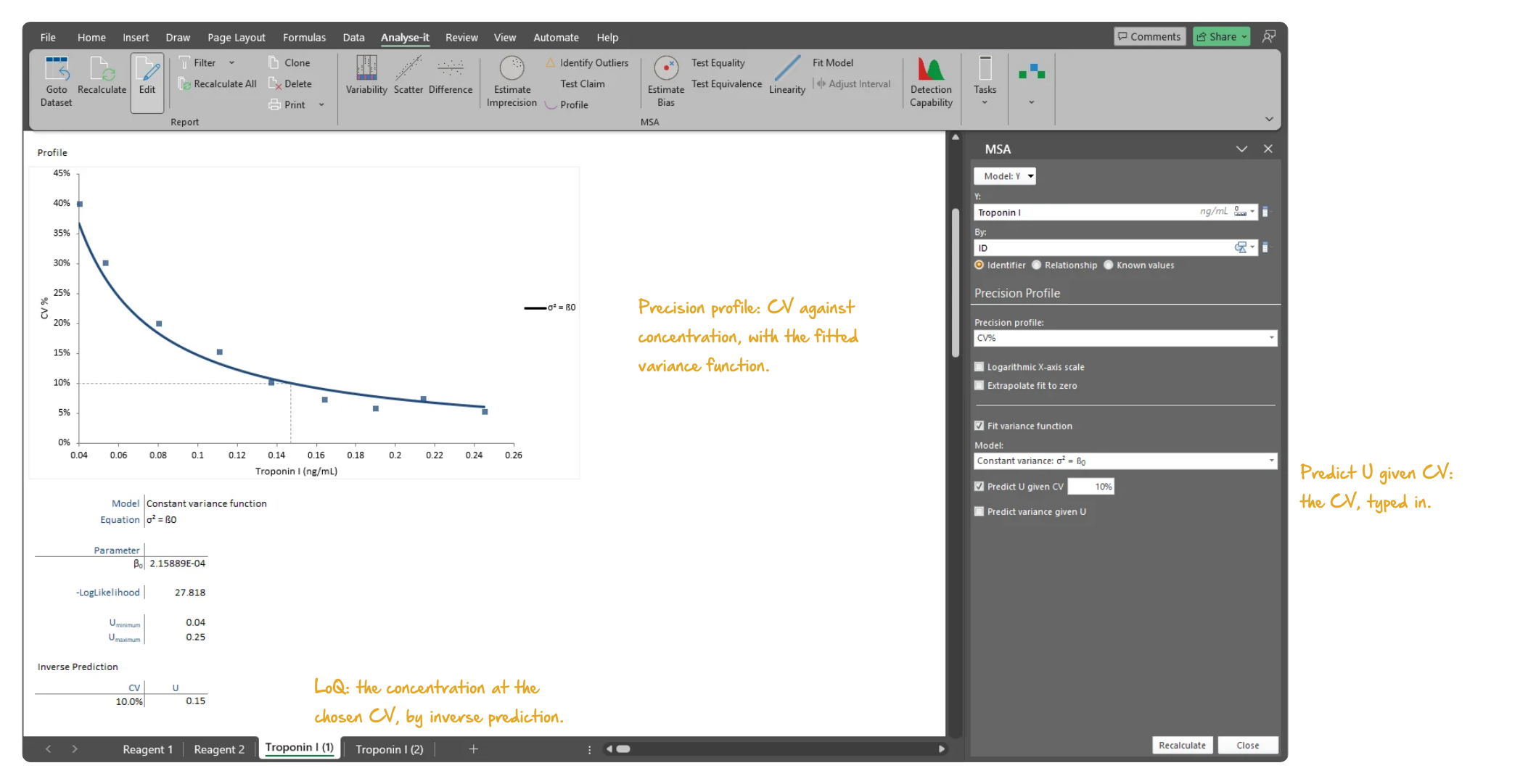
See detection capability results in detail — LoB, LoD, probit regression and LoQ — using CLSI example datasets you can download and follow along with.
 2 pages
EP17-A2 — Appendix A
2 pages
EP17-A2 — Appendix A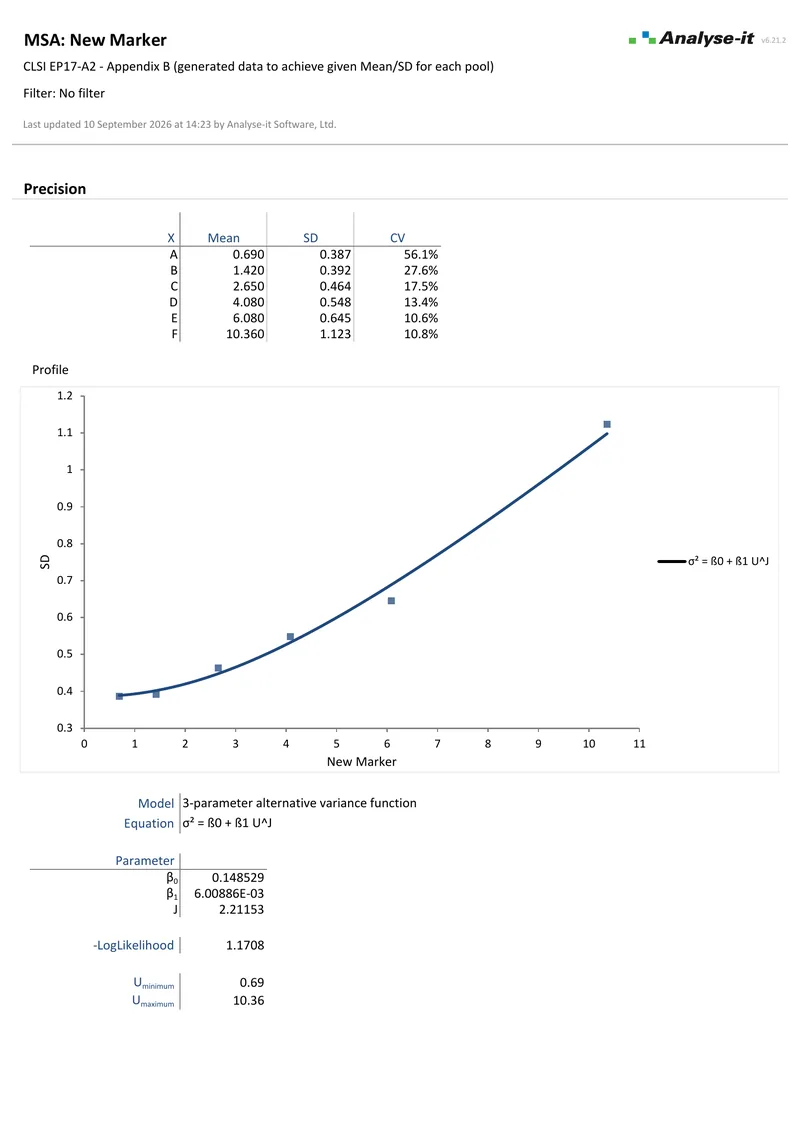 4 pages
EP17-A2 — Appendix B
4 pages
EP17-A2 — Appendix B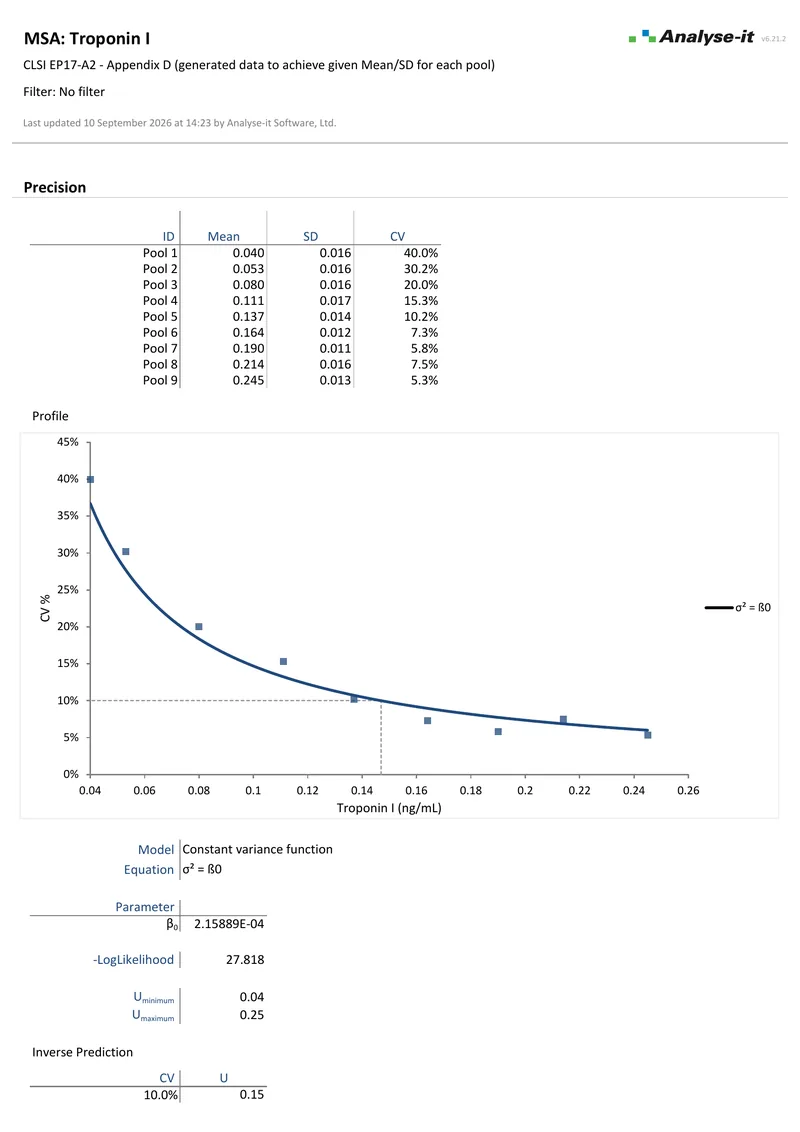 2 pages
EP17-A2 — Appendix D
2 pages
EP17-A2 — Appendix D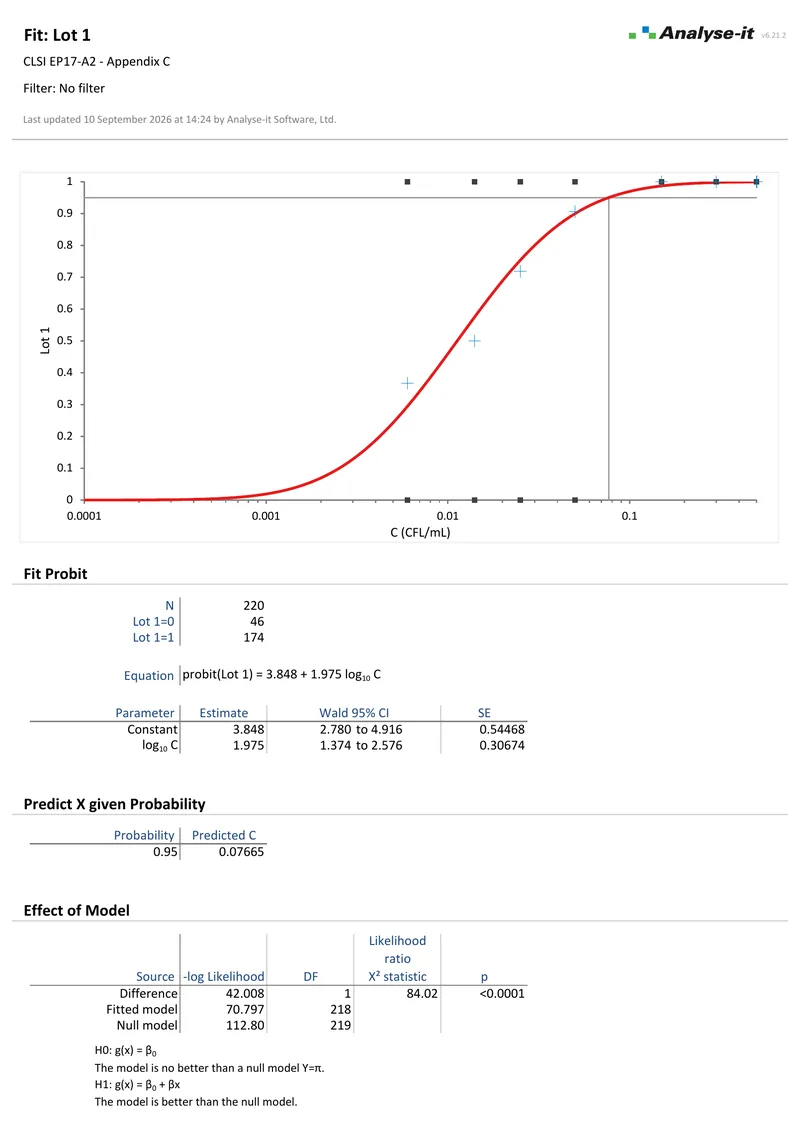 3 pages
EP17-A2 — Appendix C
3 pages
EP17-A2 — Appendix CDetection capability is one part of measurement system analysis, alongside precision (EP05-A3), linearity (EP06-Ed2), bias/trueness verification (EP15-A3) and preliminary evaluation (EP10-A3-AMD). Precision profiles from EP05-A3 feed directly into detection capability estimation.
Related guides in the Learn section: LoB, LoD and LoQ explained, the LoQ from a precision profile and probit analysis for the LoD. A further guide covers performance studies for an IVD 510(k).
Try it on your own data first. The 15-day trial is every feature from all five editions — install it and start straight away.
Method Validation edition: US$ 475 per year or US$ 1155 for a perpetual licence. Every purchase carries a 30-day money-back guarantee. Need a quote for purchasing? Choose the licence on the pricing page and click Get a quote.