Every feature from all five editions for 15 days.
Standard edition from US$ 155 a year · 30-day money-back guarantee.
Excel’s LINEST function and the chart trendline fit a straight line and stop. Fitted to a yes/no outcome — survived or not, responded or not, defective or not — the line predicts probabilities below zero and above one. It gives no odds ratio, no confidence interval and no test of whether a predictor matters. A table of coefficients is not what clinicians or stakeholders act on. Clinicians need odds ratios they can interpret and confidence intervals they can report.
Which predictors change the odds of the outcome, and by how much? Does the model as a whole beat the null model? Does adding a term improve the fit enough to justify keeping it? At what dose do half of the subjects respond?
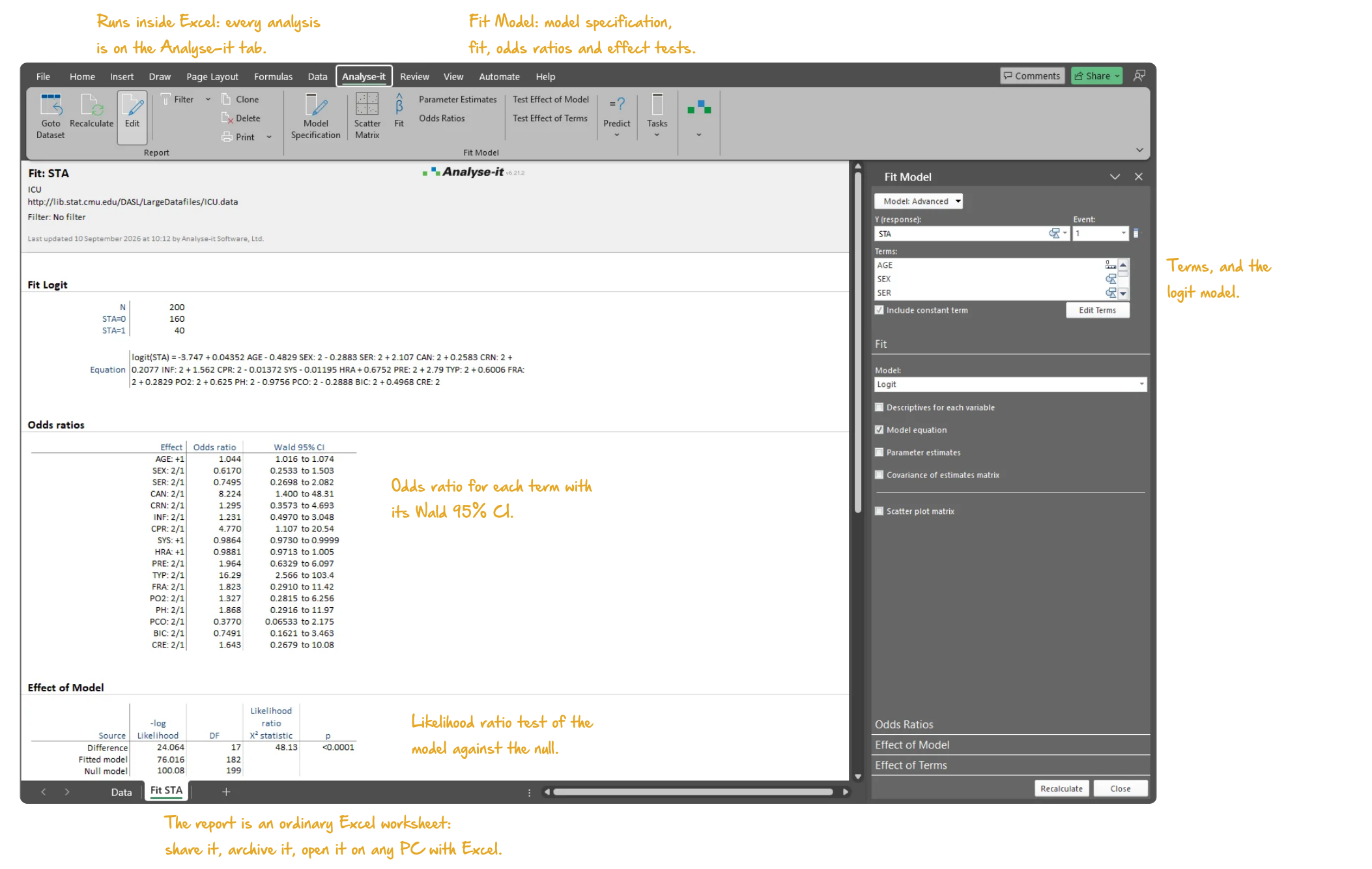
Real outcomes depend on a mix of measurements and categories, not on one variable. Binary logistic regression takes continuous and categorical predictors in the same model, with simple, crossed, polynomial and factorial terms. The dummy variables for each categorical predictor are coded automatically. The model-building workflow is the same as linear regression: add or drop a term in the task pane, Recalculate and see how the fit changes. A scatter plot shows the data.
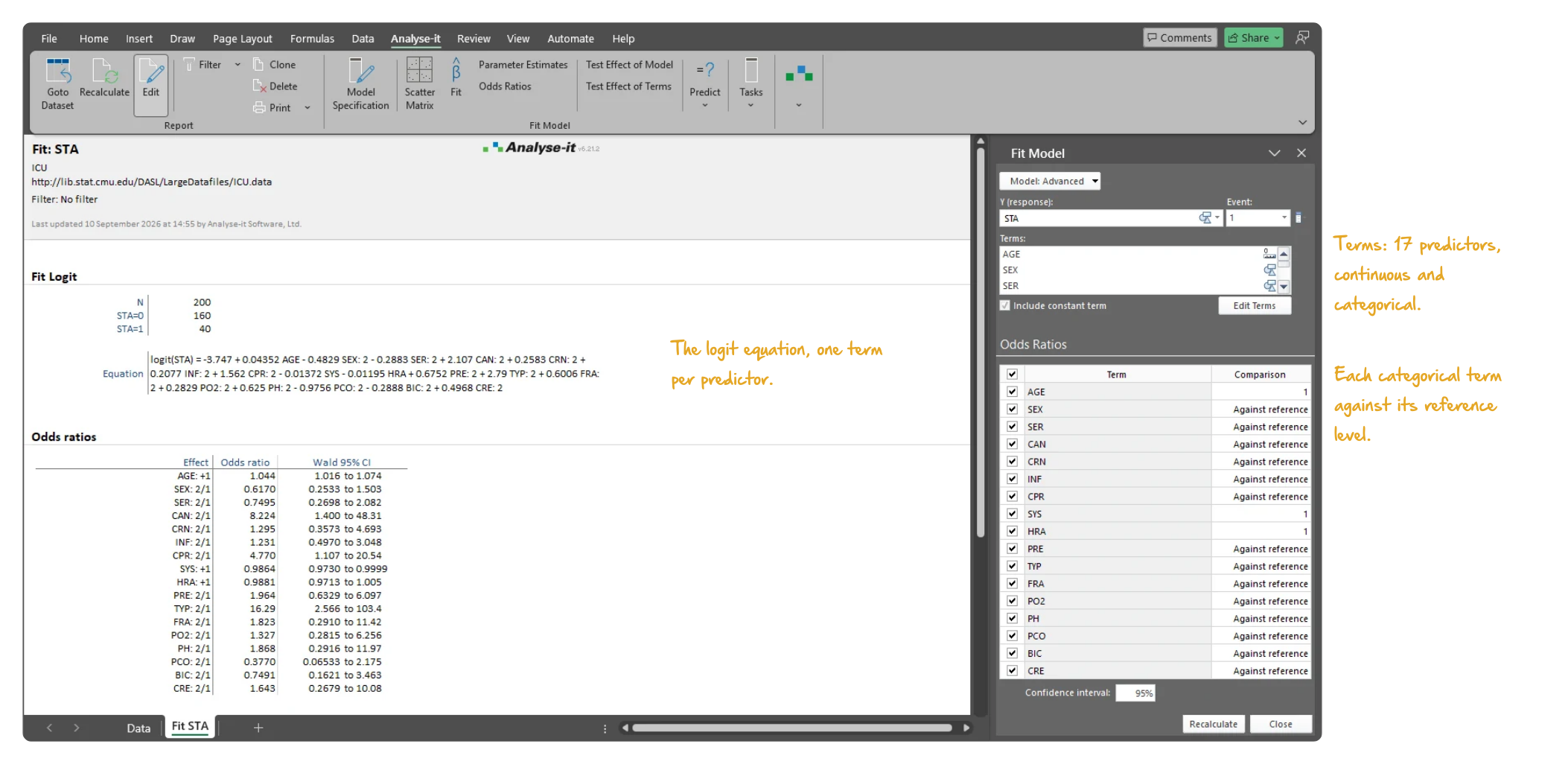
An odds ratio is the number a clinician can act on. Each predictor is reported as an odds ratio with a confidence interval. The odds ratio is directly interpretable as the change in odds per unit increase, or against the reference level of a categorical predictor. The underlying coefficients come as parameter estimates with standard errors and Wald Z statistics, with the covariance of estimates matrix and the model equation for documentation.
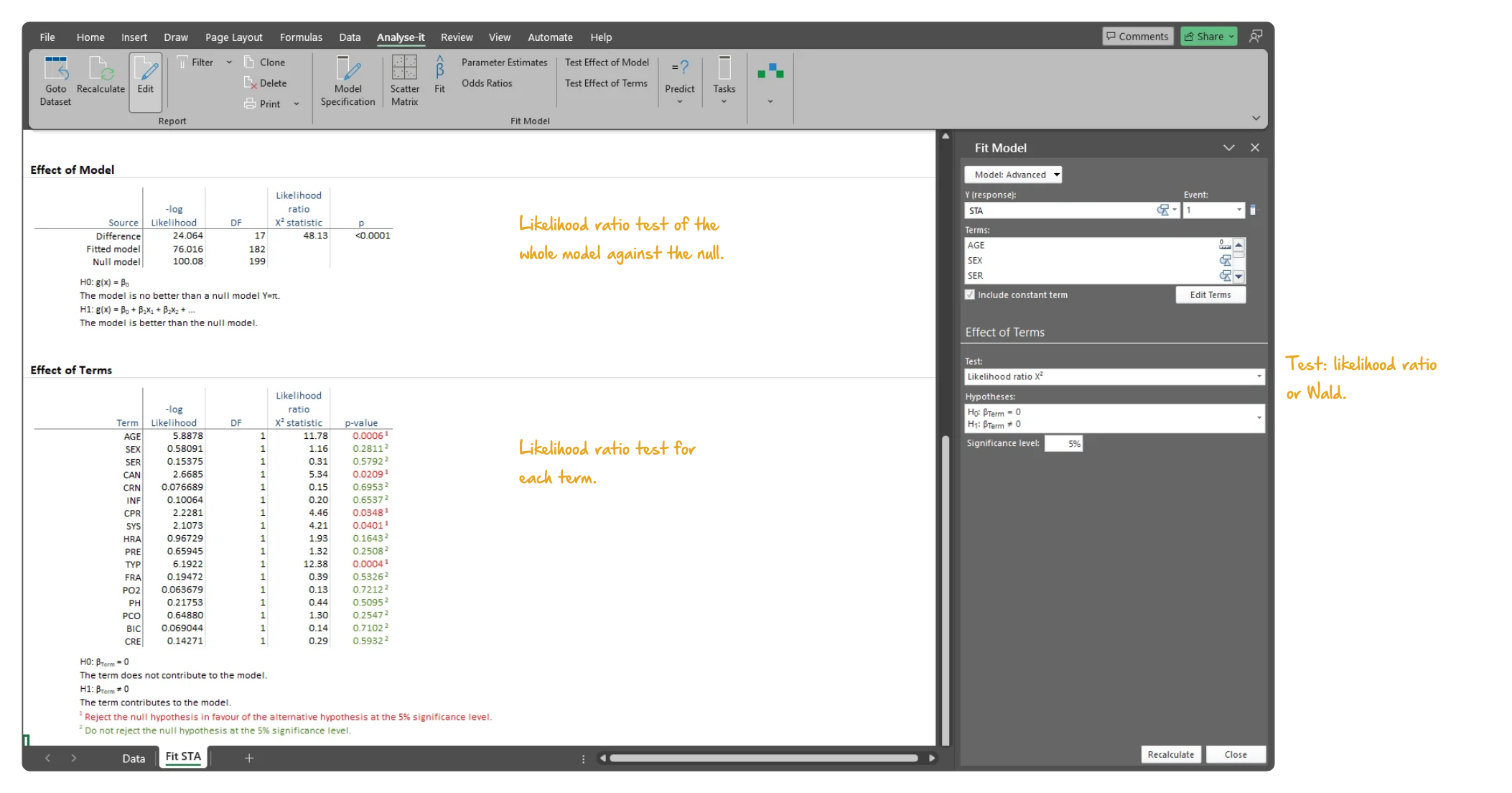
A predictor that does not contribute should be dropped, and the evidence for each one is in the analysis. The effect of model test shows whether the predictors collectively improve on the null model. The effect of terms test shows whether each term contributes or can be dropped, by likelihood ratio or Wald χ² test. Log-likelihood, AIC, BIC and deviance compare nested models — add a term and see whether the fit improves enough to justify the complexity.
Often the question is not the probability at a given X but the X at which the outcome reaches a given probability. Inverse prediction gives that value with a confidence interval. For a dose-response study, that is the dose at which 50% of subjects respond. For a diagnostic assay, it is the concentration at which detection probability reaches 95%.
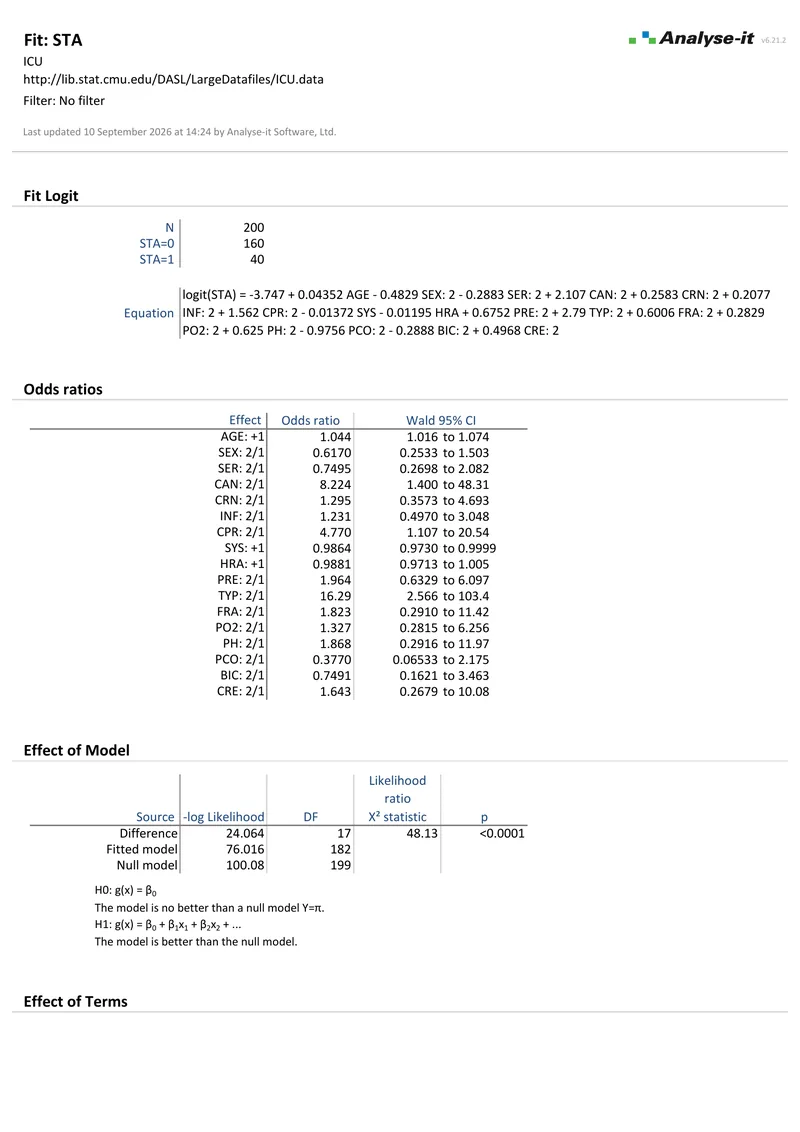
See logistic regression results in detail — odds ratios, model tests and the likelihood ratio test for each term.
Logistic regression is one part of a complete statistical analysis toolkit. The Standard edition also includes simple and multiple regression, ANOVA and ANCOVA, PCA and factor analysis, descriptive statistics, hypothesis testing, correlation and categorical data analysis. See everything in the Standard edition →
New to the model? Read logistic regression and odds ratios explained, including why a constant odds ratio does not mean a constant change in probability.
Try it on your own data first. The 15-day trial is every feature from all five editions — install it and start straight away.
Standard edition: US$ 155 per year or US$ 395 for a perpetual licence. Every purchase carries a 30-day money-back guarantee. Need a quote for purchasing? Choose the licence on the pricing page and click Get a quote.