
Creatinine runs higher in men than women. Alkaline phosphatase shifts with age. Many analytes vary enough between subgroups that a single reference interval spanning all of them would misclassify results at the margins. For those, separate partitioned intervals are needed.
For others, the subgroups barely differ and partitioning just fragments the sample for no gain. The question is how to tell which case you are in. The answer is not “whichever looks different”.
Partitioning is not free. Each partition needs its own adequate sample: 120 reference individuals per group for the non-parametric method. Splitting by sex doubles the recruitment. Splitting by sex and three age bands multiplies it sixfold.
Partition on every factor that looks even slightly different and one of two things happens. Either you need an enormous reference study, or you end up with intervals each estimated from too few individuals to be reliable. Partitioning should be reserved for differences that genuinely matter clinically, not applied reflexively.
Harris and Boyd gave a principled way to decide, and its logic is worth understanding rather than just running. A visible difference between two subgroups’ means can be real or can be an artefact of sampling. With large enough groups, even a trivial difference becomes statistically detectable.
So the test standardises the difference in subgroup means by its standard error, and compares the result against a critical value that scales with sample size. That scaling is deliberate: it stops large samples flagging clinically irrelevant differences as grounds to partition. The test also weighs the ratio of the subgroups’ standard deviations, since subgroups can differ in spread as well as in location.
When either the standardised difference in means or the ratio of standard deviations exceeds its threshold, partitioning is warranted. When both sit below, a combined interval serves. The important feature is that scaling with sample size. A plain significance test on the difference in means would push you to partition analytes that do not need it.
Sex and age are the usual partitions, but the same logic applies to any factor that plausibly shifts the analyte. Two cautions. First, age is continuous, so the number and placement of age bands is a judgement. Too few and you blur real change. Too many and each band has too few individuals to estimate a stable interval. Let the biology and the Harris–Boyd criteria guide the cut-points rather than round numbers.
Second, resist compounding partitions. Sex × age × ethnicity multiplies the groups quickly, and each needs its own 120 for the non-parametric method. Partition on the factors the evidence supports, at the coarsest granularity that captures the real difference.
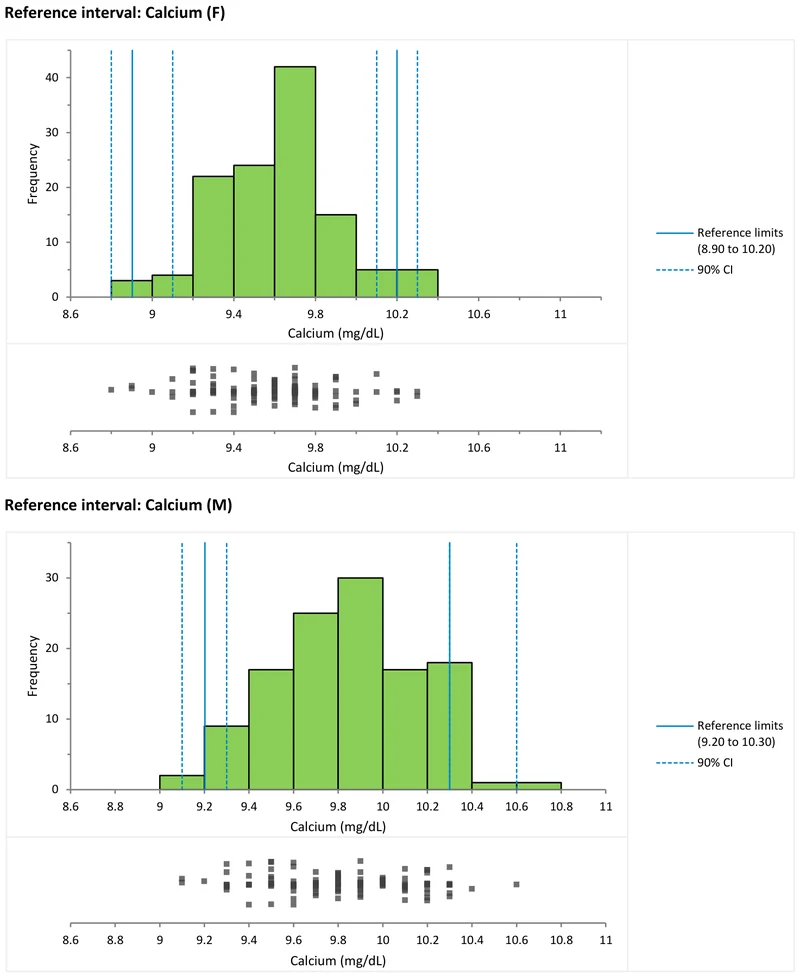
Download the CLSI EP28-A3c partitioned example workbook (.xlsx): a calcium reference interval partitioned by sex, with non-parametric limits and 90% confidence intervals for each group, ready to open in the Analyse-it trial.
The example workbook is downloading.
It opens in Excel on its own — the data and the finished results are both in it. Analyse-it is what lets you change the analysis and re-run it, try the same study on your own data, or work through it to see how the software handles it.
Every feature from all five editions for 15 days.
Partitioning on a significant difference alone. A large study makes trivial differences significant. Use the Harris–Boyd criteria, which scale with sample size, not a bare significance test.
Partitioning without the sample to support it. Each partition needs its own adequate sample. Splitting a 120-individual study by sex leaves 60 per group, too few for a stable non-parametric interval.
Over-partitioning. Every added factor multiplies the groups. Partition only on factors that genuinely matter, at the coarsest banding that works.
Ignoring differences in spread. Subgroups can share a mean but differ in variance. Harris–Boyd weighs the ratio of standard deviations too, not just the means.
Analyse-it estimates the interval for each subgroup you analyse, inside Excel:
Every feature from all five editions for 15 days. Reference intervals are in the Medical, Method Validation and Ultimate editions, from US$ 340 a year. Validated against NIST and CLSI reference datasets. See choosing a reference interval method.