
The EP series from the Clinical and Laboratory Standards Institute (CLSI) covers quantitative and qualitative method validation end to end. The naming (EP05, EP09, EP17, EP28) tells you nothing about which one your task needs. This page maps the protocols to the questions they answer. Start from “I need to know X about my method” and arrive at the right procedure, and the right depth of study, with a guide for each step.
Before choosing a protocol, settle the question that determines how much work each one is: are you validating a method from scratch or verifying a manufacturer’s claims? An unmodified, cleared assay used as intended needs verification: short studies confirming stated performance. A laboratory-developed or modified method needs validation: fuller studies establishing performance yourself. The same characteristic (precision, say) has a short verification protocol and a full establishment protocol. Picking the wrong one wastes weeks or leaves a gap. This decision runs through everything below.
| The question | Protocol | Guide |
|---|---|---|
| Is this method even worth full validation? | EP10-A3 (preliminary) | Rapid method evaluation |
| How precise is it? (establish) | EP05-A3 | Establishing precision |
| Does the claimed precision hold here? (verify) | EP15-A3 | Verifying precision claims |
| Does it agree with another method? | EP09-A3 | Choosing a regression · Bland–Altman |
| What is the total error of a result? | EP21-A | Total analytical error |
| Over what range is it linear? | EP06-Ed2 | Assessing linearity · measuring interval |
| What is the lowest it can detect or measure? | EP17-A2 | LoB, LoD and LoQ |
| Does a substance interfere with the result? | EP07-Ed3 | Interference and recovery testing |
| What is the reference interval? | EP28-A3c | Choosing a method |
| How well does it discriminate disease? | EP24-A2 | ROC and AUC |
| How accurate is a qualitative test? | EP12-A2 | Evaluating a qualitative test |
| Does a processed sample behave like a patient sample? | EP14-A3 | Commutability |
The table above works forwards, from a question to a protocol. Many readers arrive with the number instead, having seen it in an inspection finding, a supplier’s documentation or a colleague’s protocol. The table below lists the same protocols by number, plus EP31.
| Protocol | Title, in short | Guide |
|---|---|---|
| EP05 | Precision of quantitative measurement procedures — establishing it | Establishing precision |
| EP06 | Linearity of a quantitative measurement procedure | Assessing linearity |
| EP07 | Interference testing in clinical chemistry | Interference and recovery testing |
| EP09 | Measurement procedure comparison and bias estimation using patient samples | Choosing a regression |
| EP10 | Preliminary evaluation of a quantitative measurement procedure | Rapid method evaluation |
| EP12 | Evaluation of qualitative, binary output examination performance | Evaluating a qualitative test |
| EP14 | Commutability of processed samples | Commutability |
| EP15 | User verification of precision and estimation of bias | Verifying precision claims |
| EP17 | Detection capability — limit of blank, detection and quantitation | LoB, LoD and LoQ |
| EP21 | Total analytical error for quantitative measurement procedures | Total analytical error |
| EP24 | Assessment of the diagnostic accuracy of laboratory tests using ROC curves | ROC curves and AUC |
| EP28 | Defining, establishing and verifying reference intervals | Choosing a reference interval method |
| EP31 | Verification of comparability of patient results within one health care system | Comparing instruments within one laboratory |
Editions change. Apart from EP07-Ed3, the designations on this page are the editions Analyse-it implements. EP05, EP09, EP10, EP12, EP14 and EP21 all have newer editions. EP06-Ed2, EP07-Ed3, EP15-A3, EP17-A2, EP24-A2 and EP28-A3c are current. Check the CLSI catalogue before citing one in a validation file.
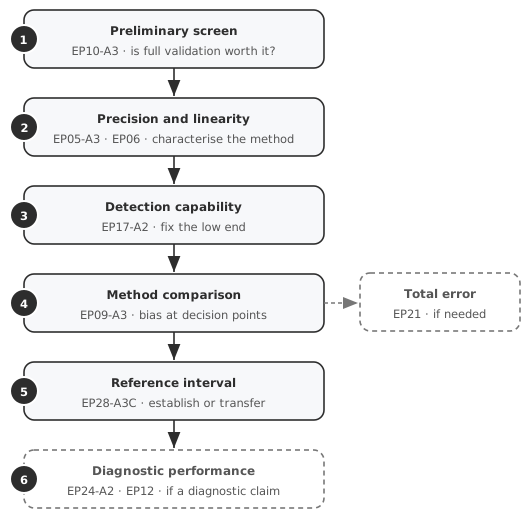
For a new quantitative method being validated in full, the studies fall into a natural sequence. A short preliminary evaluation screens out gross problems first. Then precision and linearity characterise the method on its own. Detection capability fixes the low end.
A method comparison then places it against an existing method, yielding the bias at decision points and, if needed, the total error. Next the reference interval is established or transferred, and for a diagnostic claim the diagnostic performance is characterised last. Verifying an unmodified cleared assay is the same map with most steps shortened to confirmations.
Every protocol above produces a number that has to be judged against a limit. Those limits deserve as much thought as the measurements. Where the acceptance criteria come from is its own subject. Analytical performance specifications are derived from clinical outcome, biological variation or the state of the art. The allowable total error is the limit a result is judged against. Getting the specification right is what makes a measured number a valid pass or fail. Settle the distinction between trueness, precision and accuracy early, because every protocol depends on it.
Analyse-it performs the statistical analysis behind most of the protocols on this map, inside Excel:
Every feature from all five editions for 15 days. Precision, method comparison, linearity and detection capability are in the Method Validation and Ultimate editions, from US$ 475 a year. Establishing a reference interval is also in Medical, from US$ 340 a year. Validated against NIST and CLSI reference datasets. If you are starting from a regulatory obligation rather than a statistical question, four guides come at the same map from that direction: what CLIA requires before you report a result, CAP accreditation and AMR verification, performance studies for an IVD 510(k) and method validation under ICH Q2(R2). Together, the analytical protocols here make up a measurement system analysis: precision, trueness, linearity, detection capability and interference. What goes in a validation report covers the document they all end up in.