
Allowable total error (ATE, also written TEa) is the most a single result can be wrong by and still be clinically acceptable. ATE is one of a family of limits called analytical performance specifications, and nearly every pass or fail in method validation is a comparison against one of them. Precision is acceptable if it falls below some limit, and bias if it stays within some band. Total analytical error is acceptable if it stays under the allowable total error.
Analytical performance specifications have to come from somewhere principled, because otherwise you are comparing a method against numbers someone invented. Where a limit comes from matters as much as the error you measured. Choose the wrong source and a good method can fail, or a poor one can pass. Several sources exist, and they neither always agree nor carry equal weight. The 2014 Milan consensus set out where specifications should come from and which sources to prefer. For quantitative laboratory procedures, CLSI EP46-Ed1 (June 2025) now sets out how to determine allowable total error goals and limits.
The consensus defines three models for deriving specifications. Models 1 and 2 are preferred to Model 3, and which of the first two applies depends on the measurand’s clinical role:
The preference for Models 1 and 2 matters, so fall back to Model 3 only when you must. A state-of-the-art specification beats an invented one, but it answers “what can be done?” when the question was “what is required?”.
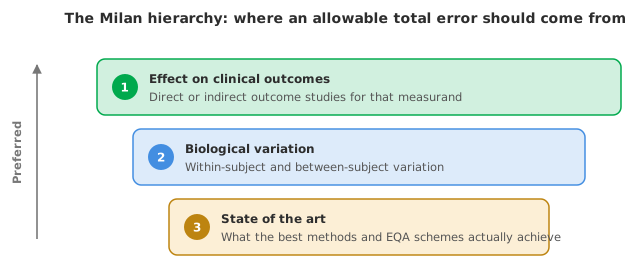
The biological-variation model rests on two quantities. Within-subject variation is how much one person’s own results fluctuate around their homeostatic set point over time. Between-subject variation is how much those set points differ across individuals. There is no point measuring far more precisely than the quantity itself naturally wanders, so the specification is pegged to that natural movement.
From those two quantities come limits for imprecision, for bias and, combined, for allowable total error, each at optimum, desirable and minimum tiers of stringency. Curated biological-variation estimates make the model usable across most routine analytes, and the EFLM database is the standard reference. Because the limit is tied to the measurand itself, it reflects neither what happens to be achievable nor a regulatory round number.
Many laboratories are bound by regulatory or external-quality-assessment limits, and these often set the operative allowable total error whether or not they are the most scientifically derived.
Proficiency-testing acceptance limits are the tolerances your results must fall within to pass an external scheme, so in effect they act as allowable total errors. A method that cannot meet them will fail the scheme whatever biological variation would permit. Because these limits carry the force of compliance, they bind even where a biological-variation limit would be looser. Treat any limit you are bound by as the minimum standard, and derive a scientific specification alongside it.
Professional bodies and expert groups publish recommended allowable total errors for many analytes. Where neither biological variation nor a regulatory limit applies, the state of the art provides a fallback: what the best current methods achieve.
State of the art, Model 3 in the hierarchy, is the option of last resort, because it describes attainable performance and not required performance. A method that meets it is meeting a target that shifts as methods improve, which is a different claim from meeting a clinical need.
The right specification is a property of the measurand and its clinical use, not a laboratory default. A target that is demanding for one analyte is lax for another. An analyte with tight biological variation demands tight analytical precision before it is useful at all. One that swings widely by nature tolerates looser analytical performance, because measurement noise is overwhelmed by the biological variation regardless. Applying a single blanket CV goal across a panel ignores that difference, and it will over-specify some assays while under-specifying others.
Because the sources can disagree, two things matter.
First, choose deliberately. Prefer the highest-standing source the situation allows: a clinical-outcome or biological-variation limit beats a state-of-the-art one. Respect any regulatory limit that binds you.
Second, state which source you used. An allowable total error of “10%” cannot be interpreted without knowing whether it came from biological variation, a proficiency scheme or a professional recommendation. Without that, a reviewer cannot judge your acceptance decision. The number is only half the specification; its source is the other half.
Quoting an allowable total error without its source. The source is part of the specification. State whether the limit came from biological variation, regulation or state of the art.
Using a blanket goal for every analyte. The right specification depends on the measurand’s biological variation and its clinical use. One CV target does not fit a whole panel.
Defaulting to state of the art when biological variation is available. State of the art describes what is achievable, so use the higher model wherever the data exist.
Defaulting to a regulatory round number when a better source exists. Proficiency limits bind you, but they are not always the most appropriate scientific target. Know when a biological-variation limit is the right one.
Mixing sources within a study. Judging bias against one source and total error against another confuses the acceptance decision. Be consistent, or be explicit about why you are not.
Treating a specification as fixed truth. Biological-variation estimates vary in quality and are revised periodically. Use a curated source and record which one you used.
A specification stands behind every acceptance judgement Analyse-it makes, inside Excel:
Every feature from all five editions for 15 days. Those specifications are applied in the method comparison and precision analyses, in the Method Validation and Ultimate editions, from US$ 475 a year.