
Commutability is the ability of a processed material to behave like a real patient sample across the measurement procedures it is used with. Reference materials, calibrators, controls and proficiency-testing samples all stand in for patient samples. You measure them and act on the result as if it told you how the method handles real specimens. The substitution only works if the material is commutable.
A non-commutable material can actively mislead. The failure is silent, which makes it one of the more easily missed problems in the calibration chain. CLSI EP14-A3 is the protocol for detecting it.
A material is commutable between two measurement procedures when it behaves like a real patient sample on both. Put precisely: the numerical relationship between the two methods’ results for that material is the same as the relationship for genuine patient samples.
Processing is the usual cause of non-commutability. Freezing, lyophilising, spiking with a purified analyte or using an artificial matrix can all change how a material interacts with an assay. The material may then read relatively high on one method and low on another, compared with how patient samples behave. A material that sits off the patient-sample relationship in this way is non-commutable.
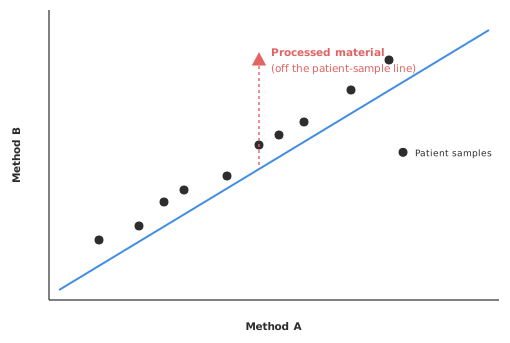
A non-commutable material gives a method-specific bias that has nothing to do with how the method performs on real patients. Use such a material as a calibrator and you transfer that artefact into every patient result. Use it in an external quality assessment scheme and a method may fail, or pass, for reasons that would never show up on patient samples. Good methods get penalised, and poor ones can look good. Nothing on the surface reveals the problem: the material gives a number, the number is off, and nothing shows that the material, not the method, is at fault.
The assessment is a comparison. Measure a panel of individual patient samples on the two (or more) measurement procedures and establish the relationship between them. The relationship is the line that genuine samples follow, with a prediction interval around it. Then measure the candidate material on the same procedures and see where it falls.
A material landing inside the prediction interval of the patient-sample relationship behaves like a patient sample, and is commutable. A material falling outside it does not, and should not be used to calibrate those methods or to judge them against one another. In effect, commutability is a method-comparison question asked of one special sample: does it lie on the line the real samples define?
Commutability is central wherever a value is transferred between methods through a material. Three settings depend on it: metrological traceability chains that carry a reference value to routine assays, the validation of calibrators and controls, and proficiency-testing schemes that compare methods. In each case, a non-commutable material breaks the assumption that the material stands in for patient samples. Establishing commutability is a prerequisite, not an afterthought, for any material meant to bridge methods.
Assuming a processed material behaves like a patient sample. Freezing, lyophilising or spiking can change how a material interacts with an assay. Commutability has to be demonstrated, not assumed.
Blaming the method for a material’s bias. A method-specific offset on a non-commutable material is an artefact of the material, not a fault in the method. Check commutability before concluding a method is biased.
Calibrating with a non-commutable material. Its artefact transfers into every patient result. Establish commutability before a material is used to calibrate.
Assuming commutability only matters for reference materials. The same trap catches the material used for recurring comparability checks between instruments and for analytical measurement range (AMR) verification. A result on a non-commutable material describes the material rather than the method.
Judging methods in a scheme built on non-commutable samples. Pass or fail becomes about the sample, not the method. Commutable materials are a prerequisite for a fair comparison.
Commutability is a method-comparison question — whether a material falls inside the prediction interval of the patient-sample relationship. Analyse-it fits that relationship on your own data, inside Excel:
Every feature from all five editions for 15 days. Method comparison is in the Method Validation and Ultimate editions, from US$ 475 a year. Validated against NIST and CLSI reference datasets.