
A rapid method evaluation under CLSI EP10-A3 is a short, structured study that screens a new method for obvious problems before you commit to a full validation. Poor precision, clear bias, nonlinearity, carryover and drift all show up in it, quickly enough to decide whether the method is worth the full effort. That effort is substantial: twenty days for precision, dozens of samples for comparison, and more for detection and linearity. Discovering a gross flaw a few days into all of that wastes the work, which is why the screen comes first.
EP10 runs a compact protocol: a handful of days, a few concentrations spanning the range, several replicates in a deliberately ordered sequence. That one small experiment yields several performance characteristics at once.
The ordering of the runs is not incidental. The sequence is arranged so that carryover and drift each leave a detectable signature. Carryover is a high sample contaminating the next; drift is a systematic trend across the run. From a few dozen measurements you get a first estimate of precision at each level, bias against the assigned values, linearity across them and the two sequence-dependent effects.
EP10 is a screen, not an establishment. The screen exists to catch problems early and cheaply, not to produce the definitive precision or bias figures you would report, which come from the full protocols.
A method that passes EP10 cleanly is worth a full validation. A method that fails badly has been ruled out before that investment. Treating an EP10 result as a substitute for EP05 or EP09 would be reading far more into a small screening study than it can bear. EP10 is a triage step: it decides what proceeds, and the real characterisation follows for whatever does.
Each characteristic is judged against an allowable limit. Imprecision at each level is judged against an allowable imprecision, and bias at each assigned value against an allowable bias. A difference plot makes the bias visible across the range.
A failure at one level or on one characteristic is exactly the kind of early warning EP10 exists to give. The failure tells you where to look before you have invested in the full study. The worked example below runs the screen on an ethanol assay. One concentration level fails the imprecision requirement, a finding far cheaper to learn now than after a twenty-day precision study.
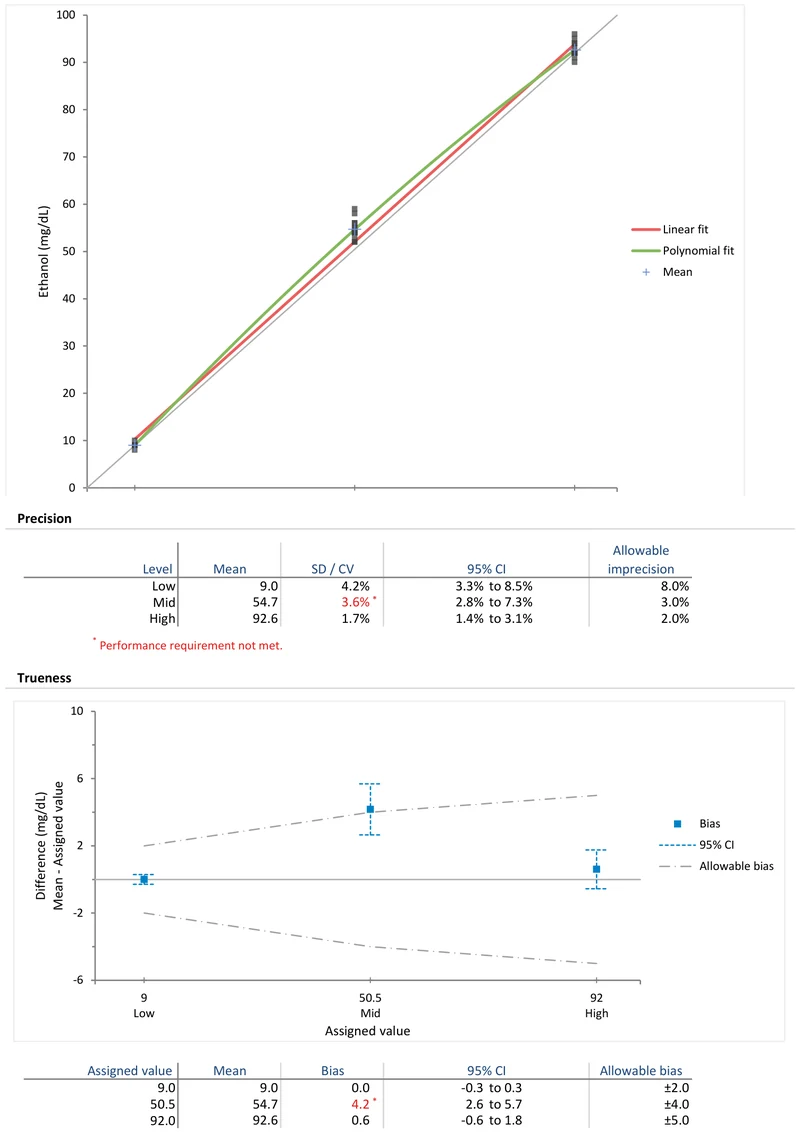
Download the CLSI EP10-A3 example workbook (.xlsx) — an ethanol preliminary evaluation of precision and bias at three levels against allowable limits, with linear and second-order fits across the measuring interval, ready to open in the Analyse-it trial.
The example workbook is downloading.
It opens in Excel on its own — the data and the finished results are both in it. Analyse-it is what lets you change the analysis and re-run it, try the same study on your own data, or work through it to see how the software handles it.
Every feature from all five editions for 15 days.
Treating EP10 as a full validation. It is a screen that flags gross problems, not a source of the definitive figures you report. The full protocols follow.
Skipping the screen and committing straight to full studies. A few days of EP10 can save weeks spent validating a method with an obvious flaw.
Running the sequence out of order. The run order is designed to expose carryover and drift. Scramble it and those effects hide.
Over-reading a pass. Passing EP10 means “worth the full effort”, not “validated”. The characterisation still has to be done properly.
Analyse-it runs the preliminary evaluation from one short study, inside Excel:
Every feature from all five editions for 15 days. Rapid method evaluation is in the Method Validation and Ultimate editions, from US$ 475 a year. Validated against NIST and CLSI reference datasets. Once a method passes, move on to establishing precision; the same allowable-limit logic underlies interference and recovery testing.