
Precision is how closely repeated results agree with one another. Trueness is how close their average lies to the true value, and accuracy is how close a single result lies to it. Ask three laboratory scientists what “accuracy” means and you may get three answers, because everyday usage has merged these ideas into one word. Metrology keeps them separate, and the separation matters. Precision and trueness name different sources of error, need different experiments and call for different corrections, while accuracy is the two together. The target analogy below shows all three at once.
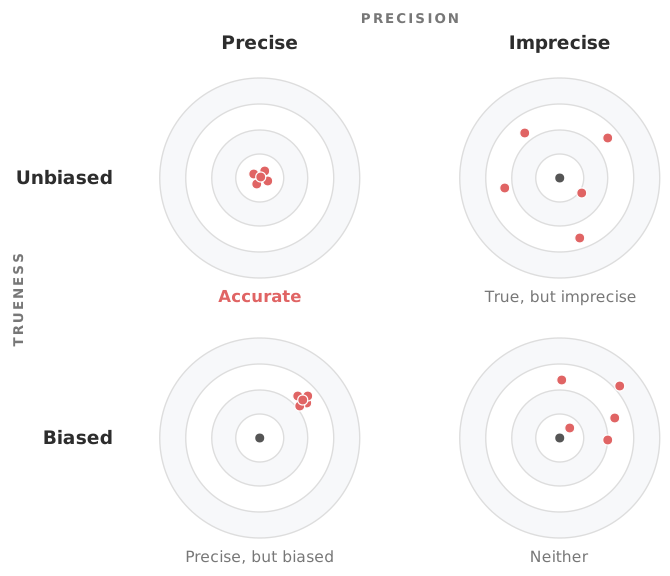
Precision is the closeness of repeated measurements to one another — how tightly the shots cluster, wherever on the target they land. Precision describes random error, so you measure it by the scatter of replicates — a standard deviation, or a coefficient of variation. A precise method gives nearly the same answer every time, but that answer can still be wrong. Precision also comes in levels, depending on how far apart in time and place the repeated measurements are: repeatability, within-laboratory precision and reproducibility.
Trueness is the closeness of the average of many measurements to the true value. On the target, that is whether the cluster of shots is centred on the bullseye or displaced to one side. Trueness describes systematic error, so you measure it by bias — the difference between the mean result and the true or accepted value. A method can be extremely precise and badly untrue, so precision alone is never enough. Note the pairing of words: trueness is the property and bias is its measure, just as precision is the property and the standard deviation is its measure.
Accuracy is the closeness of a single measurement to the true value. Accuracy is therefore the combination of trueness and precision, not a synonym for either, and the combination is the part that is easy to miss. A result can land away from the bullseye for three reasons: the method is biased, the method is imprecise, or both at once. Accuracy covers all three — how far a single result may lie from the truth. Total analytical error is the quantity that puts a number on it. Using “accuracy” to mean “trueness” is a common error, and it drops the random-error half of what you are claiming.
Precision and trueness lead to different repairs. An imprecise method needs its random error investigated: look for a noisy step, an unstable reagent or a stage that depends on the operator. An untrue method needs its bias investigated: consider recalibration, a commutable reference material or a correction against a comparison method. Calling a method “inaccurate” records that something is wrong without saying what, which leaves no clear next step. Separating inaccuracy into its precision and trueness components turns a vague complaint into a specific one.
Using “accuracy” to mean “trueness”. Accuracy includes precision. Saying accuracy when you mean bias drops the random-error half of the picture.
Treating a precise method as a good one. A method can repeat itself closely and still be centred on the wrong value. Precision without trueness is not fitness for use.
Confusing the property with its measure. Trueness is the property, bias the measure. Precision is the property, the standard deviation the measure. Keeping the two pairs straight avoids confused reporting.
Reporting one component and implying the other. A trueness result says nothing about precision, and a precision result says nothing about trueness. Fitness for use needs both, combined.
The two need different studies, and Analyse-it runs both on your own data, inside Excel:
Every feature from all five editions for 15 days. Precision and method comparison are in the Method Validation and Ultimate editions, from US$ 475 a year. Validated against NIST and CLSI reference datasets. See precision components and total analytical error.