
Measurement uncertainty (MU) is a quantity attached to a result that says how far the true value could reasonably sit from the number reported. ISO 15189 asks clinical laboratories to estimate it for the quantities they report.
The prospect sounds daunting only if you picture the bottom-up route: enumerating every individual source of error and propagating them. For a clinical measurement procedure there is a more direct path, and it reuses work you have already done.
The bottom-up method, from the GUM tradition, builds an uncertainty budget component by component. Every volume, mass and calibration contributes a term. The bottom-up approach suits a metrology institute characterising a reference procedure.
The top-down method works from the whole-procedure performance instead. The approach is set out in the Nordtest guidance, in CLSI EP29 and, for medical laboratories specifically, in ISO/TS 20914. The method takes the long-term imprecision and the bias that a validation or verification study already estimated, and combines them. For a routine measurement procedure, top-down is both more practical and more realistic. The estimate reflects the real variation the method shows in use, rather than a theoretical sum of parts.
Top-down uncertainty rests on two components. The first is imprecision: ideally the long-term within-laboratory standard deviation, from internal quality control data collected over several months. Failing that, use the within-laboratory SD from a precision study of the kind EP05 produces. The within-laboratory SD already contains between-run and between-day variation, which is the day-to-day scatter a reported result is subject to.
The second is uncertainty in the bias: not the bias correction itself, but how well that correction is known. The bias uncertainty comes from a trueness study against a reference material, or a comparison against a reference method, of the kind EP15 or EP09 produces. A validation that followed the usual protocols has already measured both components.
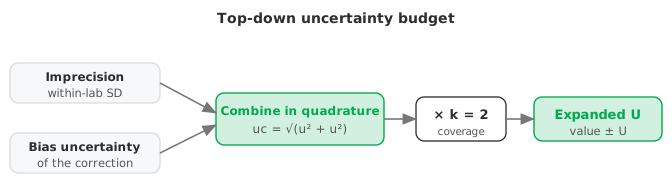
The two components combine in quadrature. The combined standard uncertainty is the square root of the sum of their squares, because independent uncertainties add as variances, not as values. The result is the standard uncertainty, the equivalent of one standard deviation.
To report an interval a clinician can use, multiply by a coverage factor, conventionally k = 2, giving roughly 95% coverage, to get the expanded uncertainty, U. A result is then reported as the value plus or minus U.
For example, a within-laboratory imprecision of 2.0% and a bias uncertainty of 1.0% combine to a standard uncertainty of √(2.0² + 1.0²) = 2.24%. At k = 2 that becomes an expanded uncertainty of 4.5%, reported as ±4.5% around each result. Whether uncertainty is expressed in the unit of measurement or as a percentage depends on how imprecision behaves across the interval. Where it is roughly proportional, a relative uncertainty is the more useful form.
Top-down uncertainty is only as complete as the study behind it. A precision estimate from a single run understates the day-to-day variation a reported result actually carries, so use the longest-term imprecision you have.
A known bias that has not been corrected must be accounted for separately. The guides differ on how. Some add it as an extra term; others widen the interval to cover it. An uncorrected bias is not the same as a small one. State the components so a reader can see what the interval is built from: the imprecision term, the bias-uncertainty term and the coverage factor.
Two CLSI EP15-A3 example workbooks supply the two components, ready to open in the Analyse-it trial:
The example workbook is downloading.
It opens in Excel on its own — the data and the finished results are both in it. Analyse-it is what lets you change the analysis and re-run it, try the same study on your own data, or work through it to see how the software handles it.
Every feature from all five editions for 15 days.
Using repeatability as the imprecision term. Within-run scatter alone understates what a result reported on any given day is subject to. Use the long-term, within-laboratory SD.
Confusing the bias with its uncertainty. The uncertainty budget needs how well the bias is known, not the bias value. Correct the bias where you can, and carry the uncertainty of the correction.
Adding components linearly. Independent uncertainties combine in quadrature, not by simple addition. Square each component, sum them, then take the square root.
Omitting the coverage factor. A bare standard uncertainty is not the 95% interval a clinician expects. State k, and report the expanded uncertainty.
Analyse-it produces the two components a top-down uncertainty is built from, inside Excel:
Every feature from all five editions for 15 days. Precision and bias estimation are in the Method Validation and Ultimate editions, from US$ 475 a year. Validated against NIST and CLSI reference datasets. See total error or measurement uncertainty for how the two frameworks compare.