
Establishing a reference interval from scratch is expensive. The non-parametric method needs at least 120 reference individuals per partition, and a partitioned analyte multiplies that number. Much of the time, you do not have to establish an interval at all.
CLSI EP28-A3c lets you transfer a well-characterised interval and confirm it holds in your population with a far smaller study. The interval can come from the manufacturer, from the literature or from another method. Knowing when that shortcut is legitimate, and how to check it, is the difference between recruiting 120 individuals per partition and recruiting 20.
A reference interval is a property of a population measured by a method. A transfer is only sound when both are comparable. The reference population should be similar in the things that move the analyte: age and sex distribution, and any relevant demographic or geographic factors. The measurement procedure and its pre-analytical handling should be comparable, or the two methods related by a known comparison so the interval can be converted across.
Where the populations or methods differ materially, the borrowed interval may simply be wrong for you. No amount of verification rescues a transfer that should not have been attempted.
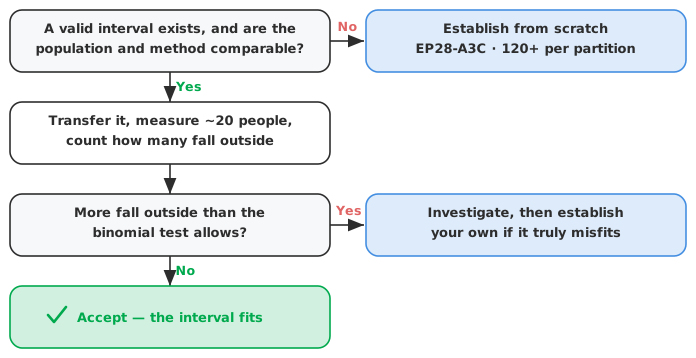
Verification asks a modest question: does the transferred interval fit my population? Answering it takes only a small sample. EP28-A3c describes verifying with 20 reference individuals per partition. Measure them, then count how many fall outside the transferred interval. If no more than two of the 20 fall outside, accept the interval. If three or four fall outside, test a second group of 20. If more fall outside, re-examine the interval before you adopt it.
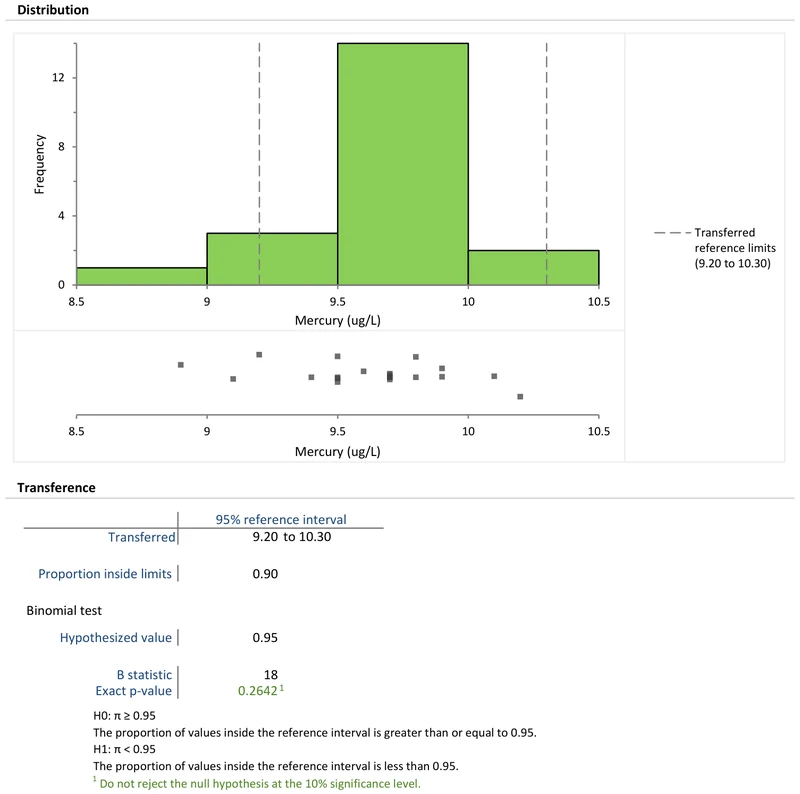
The threshold is not arbitrary. A 95% reference interval should, by definition, exclude about 5% of a matching reference population. In 20 individuals you expect one outside on average. A binomial test formalises the rule, telling you whether the number falling outside is consistent with the interval being correct or too many to be chance. When the interval fits, three or more fall outside with probability 0.075, so a correct interval fails the two-of-20 rule about 7.5% of the time. The rule also has little power at this sample size. An interval with 15% of your population truly outside still passes the two-of-20 rule about 40% of the time. In the worked example below, two of the 20 fall outside the transferred mercury interval for each sex, so both intervals are accepted (binomial p = 0.26).
Too many individuals outside the transferred interval is a useful result, not a wasted study. First check the obvious: a genuine population difference, a pre-analytical or methodological mismatch, or an outlier or two in your small sample distorting the count.
If the interval does not fit because your population really is different, you have your answer. The right response is to establish an interval of your own rather than force a borrowed one that does not describe your patients. For a borderline count, the second group of 20 that EP28-A3c prescribes helps separate a real misfit from chance variation in a sample of 20.
Download the CLSI EP28-A3c transfer example workbook (.xlsx) — a mercury reference interval transferred and verified against a small sample with a binomial test, ready to open in the Analyse-it trial.
The example workbook is downloading.
It opens in Excel on its own — the data and the finished results are both in it. Analyse-it is what lets you change the analysis and re-run it, try the same study on your own data, or work through it to see how the software handles it.
Every feature from all five editions for 15 days.
Transferring across mismatched populations or methods. Verification cannot fix a transfer that was never valid. Confirm the population and method are comparable first.
Reading a small verification sample too strictly. With 20 individuals, one or two outside is unremarkable. Use the binomial test rather than reacting to a single exceedance.
Adopting a failed interval anyway. If too many fall outside, the interval does not fit your population. Establish your own rather than report one you have shown to be wrong.
Establishing when you could transfer. If a valid interval exists and your population matches, a 20-sample verification saves recruiting 120. Transfer first, and establish your own interval only if the verification fails.
Analyse-it transfers and verifies intervals per EP28-A3c, on your own verification sample, inside Excel:
Every feature from all five editions for 15 days. Transfer and verification are in the Method Validation and Ultimate editions, from US$ 475 a year. Establishing an interval is also in Medical, from US$ 340 a year. Validated against NIST and CLSI reference datasets. See choosing a reference interval method, or the reference interval reference guide for the technical detail.